Introduction
Mental health treatment is not just about identifying symptoms; it is about understanding the individual behind those symptoms. Every person experiences psychological difficulties differently, and two individuals with the same diagnosis may have entirely different emotional, cognitive, and behavioral patterns. With advancements in mental healthcare, treatments such as Deep Transcranial Magnetic Stimulation (Deep TMS) are offering new possibilities for individuals experiencing certain mental health conditions. However, effective treatment begins with accurate assessment.
This is where psychological testing plays a crucial role.
Combining comprehensive psychological assessment with advanced treatment approaches such as Deep TMS can help mental health professionals develop a more informed, structured, and individualized treatment plan.
What Is Psychological Testing?
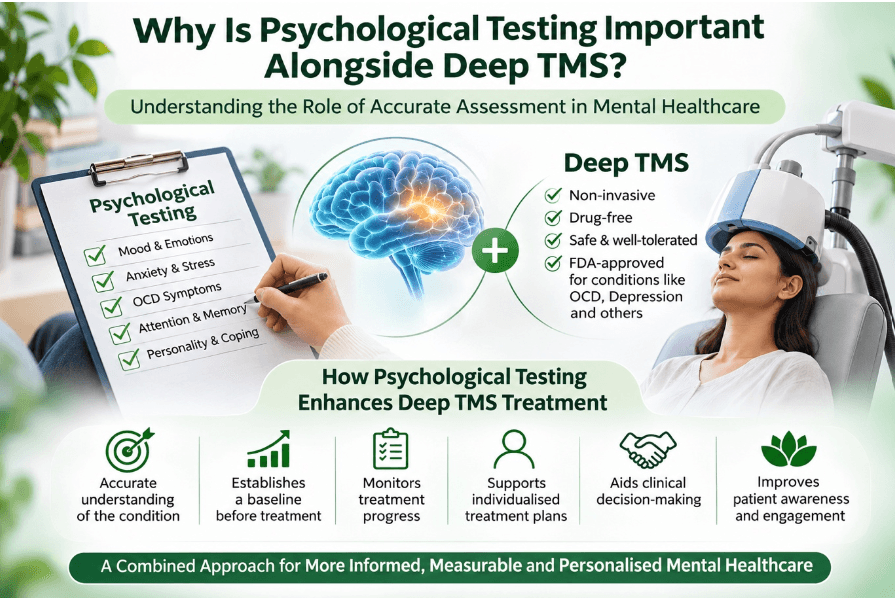
Psychological testing is a scientific and systematic process used to understand an individual's mental, emotional, behavioral, and cognitive functioning. It involves the use of standardized psychological tools, questionnaires, inventories, and assessment techniques to evaluate different aspects of psychological well-being.
Depending on the individual's needs, psychological testing may assess:
· Depression and anxiety symptoms.
· Obsessive-compulsive symptoms (OCD).
· Attention, concentration, and memory.
· Personality characteristics and emotional functioning.
· Stress levels and coping mechanisms.
· Cognitive abilities and executive functioning.
· Behavioral patterns and psychological concerns.
These assessments provide valuable information that may not always emerge through a clinical conversation alone.
Why Is Psychological Testing Important Before Deep TMS?
Deep TMS is an advanced, non-invasive brain stimulation treatment that uses magnetic pulses to stimulate specific brain regions associated with particular mental health conditions.
While Deep TMS can be an effective treatment option for appropriately selected patients, it is important to understand that treatment should never be based on symptoms alone.
Psychological testing can support the treatment process in several important ways.
1. Accurate Understanding of the Patient's Condition
Mental health conditions can have overlapping symptoms. For example, difficulty concentrating may be associated with depression, anxiety, ADHD, sleep disturbances, or other psychological concerns. Psychological assessments help clinicians understand the nature, severity, and pattern of symptoms.
This information can support a more comprehensive clinical evaluation and help determine whether Deep TMS may be an appropriate treatment option.
2. Establishing a Baseline Before Treatment
One of the most important advantages of psychological testing is establishing a baseline. Before beginning Deep TMS, standardized assessment tools can help document the patient's initial psychological condition.
For example:
· Depression severity can be assessed using tools such as PHQ-9 or BDI-II.
· Anxiety symptoms can be evaluated using GAD-7 or other appropriate measures.
· OCD symptoms can be assessed using the Yale-Brown Obsessive Compulsive Scale (Y-BOCS).
These baseline scores provide a reference point for evaluating changes during and after treatment.
4. Developing Individualized Treatment Plans
Every patient has a unique psychological profile.
Psychological testing provides additional information that helps clinicians understand individual needs, strengths, and areas requiring attention.
Based on clinical evaluation and assessment findings, professionals can determine whether Deep TMS, psychotherapy, medication, or a combination of interventions may be appropriate.
This encourages a more personalized approach rather than following a one-size-fits-all treatment model.
5. Supporting Clinical Decision-Making
Deep TMS is not suitable for every individual or every mental health condition.
A comprehensive assessment helps clinicians consider the patient's symptoms, diagnosis, treatment history, medical background, and overall suitability.
Psychological testing adds valuable information to this decision-making process, while the final treatment recommendation remains a clinical decision made by qualified professionals.
6. Improving Patient Awareness and Engagement
Psychological testing also helps patients understand their own mental health.
When individuals receive an explanation of their assessment findings, they may gain better insight into their emotional patterns, psychological difficulties, and treatment goals.
This can encourage active participation in treatment and improve communication between patients and mental health professionals.
Understanding the Connection Between Psychological Testing and Deep TMS
Psychological testing and Deep TMS serve different but complementary purposes.
Psychological testing helps understand and measure psychological functioning, while Deep TMS is a treatment intervention that uses magnetic stimulation to influence targeted brain networks.
Together, they can contribute to a more structured treatment journey.
Psychological testing helps establish baseline measurements, identify areas of concern, and monitor changes in symptoms. Deep TMS, on the other hand, provides non-invasive brain stimulation according to an appropriate clinical protocol.
This combination allows mental health professionals to approach treatment through both systematic assessment and evidence-based intervention.
The Role of Technology in Modern Mental Healthcare
Mental healthcare is evolving beyond traditional approaches. Advancements in psychological assessment, digital screening, and brain stimulation technologies are creating opportunities for more structured and accessible mental health services.
Deep TMS represents an important development in non-invasive neuromodulation. It uses magnetic fields to stimulate targeted brain regions without requiring surgery.
Depending on the clinical indication and approved protocol, Deep TMS may be considered for conditions such as treatment-resistant depression and obsessive-compulsive disorder.
However, it is essential to understand that Deep TMS is not a replacement for comprehensive psychiatric evaluation, psychological care, or other clinically indicated treatments.
The integration of psychological testing, clinical expertise, and advanced treatment technologies can help strengthen the quality of mental healthcare.
Why Choose an Integrated Mental Healthcare Approach?
At Positive Mind Care & Research Centre, we believe that effective mental healthcare begins with understanding the individual.
Our approach focuses on bringing together psychological assessment, professional clinical evaluation, counselling, and advanced treatment technologies such as Brains Way Deep TMS.
An integrated approach aims to:
· Understand the patient's psychological needs.
· Identify and measure symptoms using appropriate assessment tools.
· Support informed clinical decisions.
· Monitor progress through structured evaluations.
· Encourage personalized and evidence-based care.
Our objective is to make mental healthcare more systematic, accessible, and patient-centered.
Conclusion: Better Assessment Leads to Better-Informed Treatment
Mental health treatment should never be limited to identifying symptoms and selecting an intervention. Understanding the individual's psychological condition, establishing measurable treatment goals, and monitoring progress are equally important.
Psychological testing provides a scientific foundation for understanding mental health concerns, while Deep TMS offers an advanced treatment option for appropriately selected individuals
Because the first step towards effective mental healthcare is not just treating the mind, but understanding it.