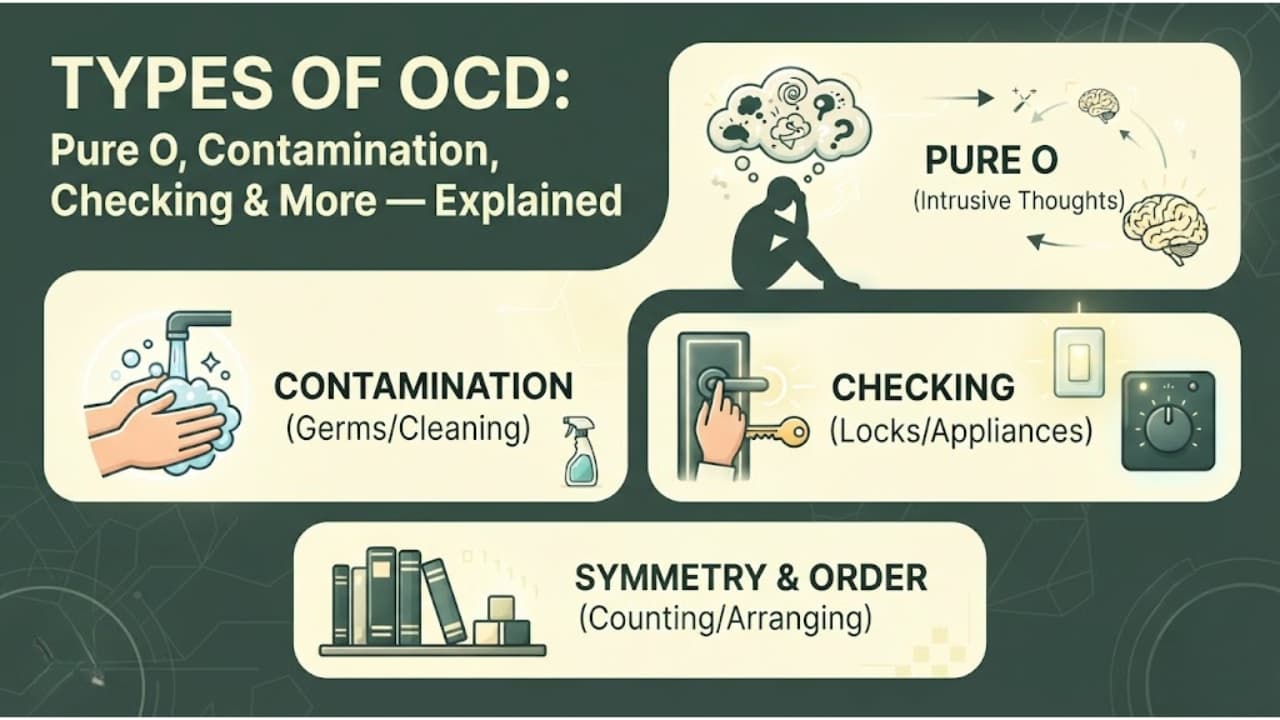
One of the most persistent and damaging misconceptions about OCD is that it manifests in a single, recognizable way — the handwasher, the lock-checker, the person who can't leave the house without verifying the stove is off seventeen times. This narrow image causes countless people whose OCD looks nothing like this to spend years undiagnosed, searching for an explanation for their suffering in entirely the wrong places.
OCD is, in reality, a disorder with a remarkably wide spectrum of presentations. The underlying mechanism is the same — obsessions trigger distress, compulsions provide temporary relief, and the cycle repeats and strengthens — but the specific content of obsessions and the form compulsions take varies enormously from person to person. Understanding the main types of OCD is essential for recognizing the condition in its less obvious forms and seeking appropriate treatment.
Contamination OCD
This is the most widely recognized OCD presentation, and also the one most often depicted in media. People with contamination OCD experience intense fears about being contaminated by germs, dirt, chemicals, bodily fluids, or sometimes more abstract contamination (moral or emotional "dirtiness"). Compulsions typically involve excessive washing, cleaning, and avoidance of perceived contamination sources.
What isn't often communicated is how disabling this can become. Washing rituals may consume hours each day, resulting in raw, damaged skin. Entire areas of the home may become "clean" zones that cannot be entered with outside clothes. Eating out, using public restrooms, or shaking hands can become impossible. Life progressively contracts around contamination rules that others don't see and may not understand.
Checking OCD
People with checking OCD experience obsessional doubts about whether they have done — or failed to do — something that could result in harm. Did I lock the door? Did I turn off the gas? Did I send that email with the wrong attachment? Did I accidentally run someone over while driving?
The compulsive response is to check — repeatedly. What might take a few seconds for most people can take an hour for someone with checking OCD, and even after checking, the doubt immediately returns: "But did I really check properly?" Some patients drive back along a route multiple times convinced they may have hit a pedestrian, despite having seen nothing. The checking is never enough because the doubt is generated by OCD, not by any actual uncertainty.
Harm OCD
Perhaps the most distressing and least publicly understood type, harm OCD involves intrusive thoughts, images, or impulses about causing harm to others — usually those the person loves most. A new mother may experience intrusive images of harming her baby. A caring partner may have sudden intrusive thoughts involving violence against their spouse. A gentle person may experience urges to push someone in front of a vehicle.
These intrusive thoughts are profoundly distressing precisely because they are completely contrary to the person's own values and desires. No one with harm OCD wants to harm anyone — the intrusive thought is as unwanted to them as it would be to an outside observer. Understanding this distinction is critical, since the shame and fear that harm OCD thoughts generate often prevents people from disclosing them, when disclosure to an experienced clinician is exactly what leads to accurate diagnosis and treatment.
Scrupulosity OCD
Scrupulosity involves obsessions with religious, moral, or ethical themes. Religious scrupulosity typically involves intrusive blasphemous thoughts, excessive doubt about whether one has sinned, or compulsive praying and confession to neutralize perceived moral wrongdoing. Moral scrupulosity involves obsessive fears of being a bad person, having been dishonest, or having inadvertently harmed someone through past actions.
Scrupulosity OCD can be particularly complex to treat because the line between genuine religious practice and OCD-driven ritual can be unclear without experienced clinical assessment. Clinicians familiar with scrupulosity can identify when religious observance has crossed into compulsive territory driven by OCD, and can design ERP approaches that distinguish between spiritually meaningful practice and OCD-maintaining ritual.
Symmetry and Order OCD
This type involves obsessions about symmetry, exactness, and order, accompanied by a persistent "just right" feeling that must be achieved through arranging, aligning, or performing actions a specific number of times. Unlike simple preference for organization, OCD-driven symmetry compulsions cause significant distress if interrupted and consume disproportionate amounts of time.
Pure O: Primarily Obsessional OCD
Pure O is arguably the most commonly misdiagnosed OCD presentation because it lacks obvious visible rituals. People with Pure O experience relentless intrusive thoughts — across any of the themes above, but particularly harm, sexual, or relationship themes — and respond with internal, mental compulsions: rumination, mental reviewing, mental arguing, compulsive prayer, or internal reassurance-seeking.
Because these compulsions are invisible to others, Pure O patients are often misdiagnosed with depression, generalized anxiety, or even psychosis. Their OCD responds to the same treatments as other OCD presentations — ERP targeting mental compulsions, and Deep TMS for resistant cases — but requires a clinician specifically familiar with Pure O presentations.
Relationship OCD (ROCD)
ROCD involves intrusive doubts about intimate relationships — obsessively questioning whether one truly loves their partner, whether the relationship is "right," whether one finds their partner attractive enough, or whether one's feelings are "real." The compulsive response involves constant mental reviewing, comparison, seeking reassurance from the partner, or researching "signs" of compatibility.
ROCD is often severely damaging to relationships because partners understandably interpret constant doubt-expression as genuine ambivalence, without realizing they are witnessing OCD symptoms rather than genuine relational dissatisfaction.
Treatment Across OCD Types
All OCD subtypes respond to the same core treatment framework: ERP therapy targeting the specific obsession-compulsion cycle, SSRIs at appropriate doses, and for treatment-resistant presentations, Deep TMS using the OCD-specific H7 coil protocol. At Positive Mind Care, Gurugram, psychiatrists are experienced with the full range of OCD presentations, ensuring patients receive a treatment approach calibrated to their specific subtype rather than a generic OCD protocol.
Frequently Asked Questions
Q1. Can a person have more than one type of OCD? Yes, OCD presentations frequently overlap. A person may have contamination OCD alongside harm OCD, or symmetry OCD with scrupulosity themes. Treatment addresses all active themes simultaneously.
Q2. Do OCD themes change over time? Yes, OCD themes can shift. A person who begins with contamination OCD may later develop harm obsessions. This is normal within the disorder and doesn't indicate a new or different condition.
Q3. Is Pure O less serious than other OCD types? No. Pure O can be equally or more distressing than visible-ritual OCD, and the mental compulsions involved are just as OCD-maintaining as behavioral ones.
Q4. How does ERP differ for each subtype? The core ERP principle — exposure to feared triggers without compulsive response — applies to all types, but the specific exposures designed and the compulsions targeted are tailored to each patient's unique presentation.
Conclusion
OCD is not one condition — it is a disorder with a broad, varied spectrum of presentations, many of which don't fit the popular image at all. Whether your OCD involves contamination, harm themes, scrupulosity, relationship doubt, or primarily mental compulsions, it is recognizable, diagnosable, and treatable. Gurugram's Positive Mind Care offers specialized assessment and treatment for every OCD presentation, including advanced Deep TMS for cases where conventional treatment has been insufficient.