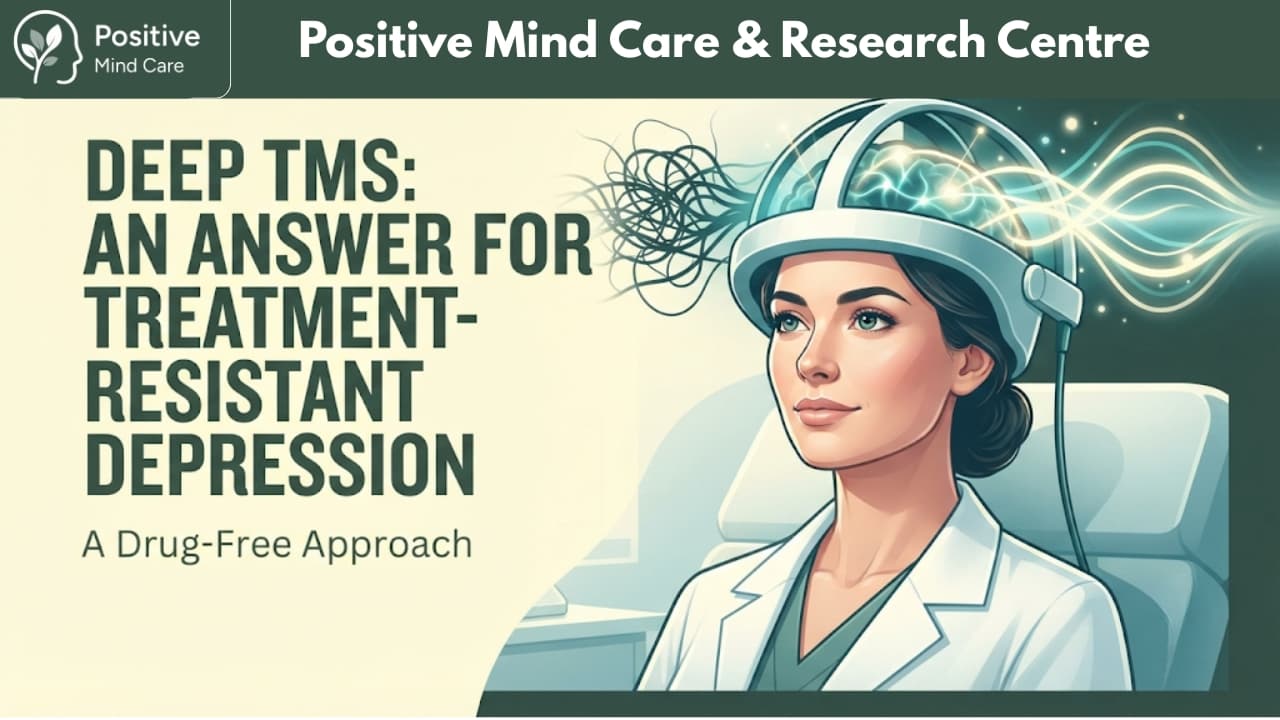
For many people with depression, the treatment journey doesn't follow a straightforward path. They try an antidepressant. It doesn't work well enough, or the side effects are intolerable. They try another. Same result. By the time a patient has failed two or three adequate medication trials, they arrive at a clinical category that defines the experience of millions of depression patients globally: treatment-resistant depression, or TRD. Far from being a rare edge case, TRD affects an estimated 30 percent of all major depression patients — a significant population who deserve treatment options that genuinely work for them.
Deep TMS therapy has emerged as one of the most important clinical advances in TRD treatment in the last two decades. This blog explains what TRD is, why it occurs, and why Deep TMS represents one of the most viable and well-evidenced solutions for patients in Gurugram who have exhausted conventional options.
Defining Treatment-Resistant Depression
The clinical definition of TRD is a Major Depressive Disorder episode that has not responded adequately to at least two antidepressant medications of adequate dose and duration (typically at least 6-8 weeks each). The word "resistant" here is not absolute — it doesn't mean the condition cannot be treated, only that standard first-line treatments have not been sufficient.
TRD is significantly more common than most people — or even some clinicians — appreciate. The STAR*D study, one of the largest depression treatment research projects ever conducted, found that after trying two antidepressant treatments in sequence, only about a third of patients had achieved remission. The majority of depression patients require more than one or two treatment adjustments, and a substantial minority need treatments beyond medication altogether.
Why Some People Don't Respond to Antidepressants
Treatment resistance in depression is not primarily about severity — many patients with quite severe depression respond well to medication, while some with moderate symptoms do not. Several factors contribute to medication non-response. Genetic variations affecting how individuals metabolize antidepressants can mean that standard doses produce inadequate medication levels, or that specific receptor profiles make certain medication classes ineffective.
Undiagnosed comorbid conditions — such as unrecognized bipolar spectrum features, OCD, or ADHD — can prevent antidepressant response if the comorbidity isn't addressed simultaneously. Trauma-related depression, particularly when PTSD underlies or accompanies the depressive symptoms, may require trauma-focused treatment alongside antidepressants to achieve full response. Inflammatory and metabolic factors — including thyroid dysfunction, vitamin deficiencies, and chronic inflammation — can maintain depression despite medication. A thorough re-evaluation of patients with TRD often uncovers one or more of these modifying factors.
What Deep TMS Specifically Offers TRD Patients
The central reason Deep TMS is so clinically valuable for TRD is its mechanism. While all antidepressant medications work through the brain's neurotransmitter chemistry — increasing serotonin, norepinephrine, or dopamine signaling — they do so through systemic, whole-body pathways. For patients whose treatment resistance is related to how their brain circuits function rather than simple neurotransmitter imbalance, this chemical approach will continue to be insufficient regardless of how many medications are tried.
Deep TMS bypasses the medication pathway entirely. It directly stimulates the neural circuits most implicated in depression — primarily the left dorsolateral prefrontal cortex — using targeted magnetic pulses. This direct neurological approach can effectively reach and modulate brain circuits that medication hasn't been able to normalize, producing meaningful improvement in patients who have failed multiple medication trials.
The pivotal clinical trials for BrainsWay Deep TMS specifically enrolled treatment-resistant patients — people who had already failed at least one antidepressant — and still demonstrated significant response rates. This is a crucial detail, because it means the evidence base directly reflects the TRD population rather than being extrapolated from treatment-naive patients.
Deep TMS Within a Comprehensive TRD Treatment Plan
Deep TMS is most effective for TRD when integrated into a comprehensive clinical approach rather than used in isolation. At Positive Mind Care, Gurugram, the management of TRD patients begins with a thorough re-evaluation that reviews all prior treatments, reassesses diagnosis, and checks for modifying factors like thyroid function, inflammatory markers, and B12/folate levels. Any identified modifying factors are addressed. Psychotherapy is integrated for patients whose depression has significant psychological components. Deep TMS then addresses the biological dimension of TRD that hasn't responded to previous interventions.
This comprehensive approach reflects current best-practice in TRD management and consistently produces better outcomes than adding Deep TMS to an otherwise unchanged treatment plan.
Managing Expectations in TRD
It is important to be honest with TRD patients about what to expect from Deep TMS. Response rates in TRD are lower than in first-episode depression patients — treatment resistance does make response less likely, not impossible. However, "lower" still means a meaningful proportion of patients who had found no adequate relief with medication respond significantly to Deep TMS, and for this group, the benefit can be life-changing.
Patients who achieve response during the acute Deep TMS course typically maintain their gains, particularly with follow-up monitoring and periodic maintenance sessions as needed. The goal is sustainable improvement in functioning and quality of life — and this is achievable for many TRD patients who work with an experienced clinical team.
The Comparison With Other TRD Treatments
It's worth briefly contextualizing Deep TMS within the broader landscape of TRD treatment options. ECT remains the most effective treatment for acute, severe, treatment-resistant depression, particularly when rapid response is needed or suicidal risk is high. Ketamine and esketamine infusions provide rapid antidepressant effects in some TRD patients but require repeat treatment and have specific safety monitoring needs. Deep TMS offers a good balance of efficacy, tolerability, and durability for the broad TRD population — without the anaesthesia requirements of ECT, the rapid-tolerance issues of ketamine, or the systemic side effects of medication escalation.
Frequently Asked Questions
Q1. How many patients with TRD respond to Deep TMS? Response rates in TRD vary across studies, but clinical trial data and real-world experience suggest meaningful response in roughly 30-40 percent of TRD patients who complete the acute course — a significant figure for a population that has already exhausted conventional options.
Q2. Should I try more antidepressants before considering Deep TMS? This is a clinical decision to make with your psychiatrist. After two adequate antidepressant trials, the incremental probability of a third medication working falls significantly, making the risk-benefit calculation for moving to Deep TMS increasingly favorable.
Q3. Can Deep TMS be given while I continue taking antidepressants? Yes. Deep TMS is safe to combine with most antidepressant medications, and many TRD patients continue their current medication while receiving Deep TMS.
Q4. What happens if Deep TMS doesn't produce adequate response? If Deep TMS doesn't produce adequate response, other TRD options — including ECT or ketamine/esketamine — can be considered. An experienced psychiatrist will guide this decision based on clinical assessment.
Conclusion
Treatment-resistant depression is not the end of the road — it is a signal that a different approach is needed. Deep TMS offers TRD patients in Gurugram a clinically validated, FDA-cleared, non-invasive treatment that works through a fundamentally different mechanism than medication and has demonstrated meaningful response rates even in patients who have failed multiple prior treatments. For anyone in Gurugram who has struggled with depression despite best efforts with conventional treatment, Deep TMS through Positive Mind Care represents a genuine next step worth pursuing.