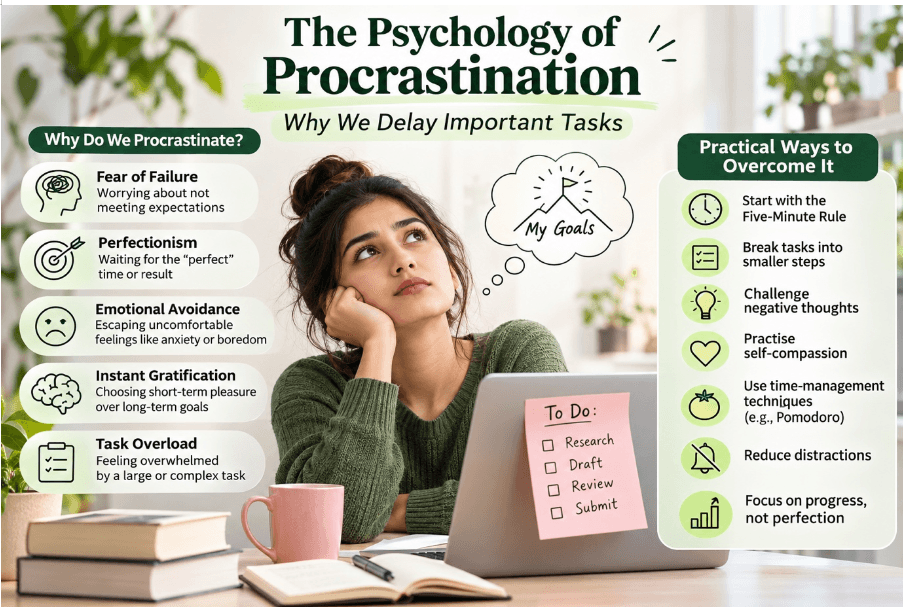
Have you ever found yourself postponing an important task even when you know it needs to be completed? Perhaps you have delayed studying for an examination, avoided an important work assignment, postponed a difficult conversation, or spent hours scrolling through social media instead of doing something productive.You promise yourself that you will start tomorrow, but tomorrow turns into another day. This behaviour is known as procrastination.Procrastination is a common psychological experience that affects people across different age groups, professions, and lifestyles. Although it is often mistaken for laziness or poor time management, psychology suggests that procrastination is much more complex. It is closely connected to our emotions, thoughts, motivation, self-regulation, and ability to manage stress.
What Is Procrastination?
Procrastination refers to the voluntary delay of an intended task despite knowing that postponing it may lead to negative consequences.It is not simply taking a break or choosing to relax. Rather, it involves avoiding something important even when we understand that completing it would be beneficial.
For example:
· A student delays preparing for an examination until the last night.
· An employee postpones an important project despite having sufficient time.
· Someone avoids making an important decision because they fear making the wrong choice.
· An individual continuously postpones personal goals, such as exercising, reading, or learning a new skill.
The interesting question is: If we know that delaying tasks can create problems, why do we continue doing it?
The Psychology Behind Procrastination
1. Fear of Failure
One of the major psychological reasons behind procrastination is the fear of failure.
People sometimes delay tasks because they are afraid that their performance will not meet expectations. They may worry about making mistakes, receiving criticism, or disappointing others.
By postponing the task, they temporarily avoid confronting these uncomfortable feelings.
For example, a student who fears getting low marks may avoid studying because beginning the preparation makes the possibility of failure feel more real.
Ironically, avoiding the task increases the likelihood of the very outcome they fear.
2. Perfectionism and Unrealistic Expectations
Perfectionism can also contribute to procrastination.
Individuals with perfectionistic tendencies may believe that everything they do must be flawless. They may spend excessive time planning, researching, or waiting for the perfect opportunity to begin.
Thoughts such as "I will start when I feel completely prepared" or "If I cannot do it perfectly, I should not do it at all" can prevent meaningful progress.
The desire to achieve perfection sometimes becomes a barrier to taking the first step.
3. Emotional Avoidance
Procrastination is often associated with emotional regulation rather than time management.
Certain tasks create uncomfortable emotions such as anxiety, frustration, boredom, confusion, or self-doubt.
When individuals postpone these tasks, they experience temporary emotional relief. They may choose activities that provide immediate pleasure, such as watching television, browsing social media, or playing games.
This creates a psychological cycle in which avoiding an unpleasant task becomes rewarding in the short term.
4. Instant Gratification and the Brain
Human beings naturally tend to prefer immediate rewards over delayed rewards.
For example, scrolling through social media provides instant entertainment, whereas studying for an examination offers benefits that may only become visible weeks or months later.
This conflict between immediate pleasure and long-term goals plays an important role in procrastination.
The brain may favour activities that provide quick satisfaction, making it difficult to remain focused on tasks requiring sustained effort.
5. Lack of Motivation and Task Overload
Sometimes procrastination occurs because a task appears too difficult, lengthy, or overwhelming.
When individuals look at a large responsibility, they may struggle to identify where to begin.
For example, completing a research project may involve reading, collecting information, analysing data, and writing. Thinking about all these responsibilities together can create mental pressure.
As a result, the individual may avoid starting altogether.
Breaking a large task into smaller and manageable activities can make it feel less intimidating.
The Procrastination Cycle
Procrastination often develops through a repeating psychological pattern:
1. Task: An important responsibility appears.
2. Negative emotions: The individual experiences anxiety, boredom, or self-doubt.
3. Avoidance: The person postpones the task and chooses a more enjoyable activity.
4. Temporary relief: Avoiding the task creates a feeling of comfort.
5. Guilt and stress: As the deadline approaches, anxiety and regret increase.
6. Last-minute action: The individual rushes to complete the task, often under pressure.
If this pattern continues, procrastination can become a habitual response to challenging situations.
How Does Procrastination Affect Mental Health?
Although occasional procrastination is common, persistent procrastination can negatively influence psychological well-being.
Increased Stress and Anxiety: Unfinished responsibilities create continuous mental pressure and worry, particularly when deadlines approach.
Reduced Self-Confidence: Repeatedly failing to complete intended tasks can weaken an individual's belief in their own abilities.
Feelings of Guilt: People may experience frustration and disappointment when their actions do not match their intentions.
Poor Academic and Professional Performance: Delaying important responsibilities may affect productivity, learning outcomes, work quality, and career development.
Emotional Exhaustion: Constantly worrying about unfinished tasks can consume mental energy and make individuals feel overwhelmed.
Over time, procrastination may create a cycle of avoidance, stress, and reduced self-esteem.
Practical Psychological Strategies to Overcome Procrastination
The good news is that procrastination can be managed by developing healthier thinking patterns and behavioural habits.
1. Follow the Five-Minute Rule
Instead of waiting for motivation, commit to working on a task for just five minutes.
Starting is often more difficult than continuing. Once you begin, you may find it easier to maintain your momentum.
2. Break Tasks into Smaller Steps
Avoid thinking about an entire project at once.
Divide it into smaller activities with achievable deadlines. Completing each small step creates a sense of progress and accomplishment.
3. Challenge Negative Thoughts
Recognise thoughts such as:
· "I am not capable of doing this."
· "I will probably fail."
· "I need the perfect time to start."
Replace them with realistic alternatives, such as "I can learn while doing it" or "Progress is more important than perfection."
4. Practise Self-Compassion
Avoid being excessively critical of yourself when you procrastinate.
Research on self-compassion suggests that responding to personal setbacks with understanding rather than harsh self-judgment can support healthier emotional coping.
Instead of saying, "I am lazy and irresponsible," try asking, "What is making this task difficult for me?"Understanding the underlying reason can help you develop a practical solution.
5. Use Time-Management Techniques
Techniques such as the Pomodoro Technique can help improve concentration.
Work for 25 minutes, take a five-minute break, and repeat the process. Adjust the intervals according to your attention span and the nature of the task.
6. Reduce Distractions
Create an environment that supports concentration. Keep your phone away, limit unnecessary notifications, and choose a comfortable place to work.
Reducing distractions makes it easier to focus on important responsibilities.
7. Focus on Progress, Not Perfection
Remember that completing a task imperfectly is often more valuable than endlessly waiting for the perfect moment.
Small, consistent actions can create meaningful long-term improvements.
When Should You Seek Professional Help?
Occasional procrastination is a normal part of human behaviour. However, when it becomes persistent and significantly interferes with academic performance, professional responsibilities, relationships, or everyday functioning, it may be helpful to seek professional support.
A mental health professional can help identify underlying emotional or behavioural difficulties, including anxiety, depression, attention-related difficulties, or unhealthy coping patterns.
Psychological approaches such as Cognitive Behavioural Therapy (CBT) may help individuals identify unhelpful thought patterns, develop effective coping strategies, and build healthier behavioural habits.
Conclusion:
Procrastination is not always about laziness, a lack of discipline, or poor time management. Often, it is a psychological response to uncomfortable emotions, fear of failure, perfectionism, and the desire for immediate gratification.Remember, you do not have to feel motivated to begin; sometimes, beginning is what creates motivation.Every small step forward brings you closer to your goals. Stop waiting for tomorrow when you can take the first step today.