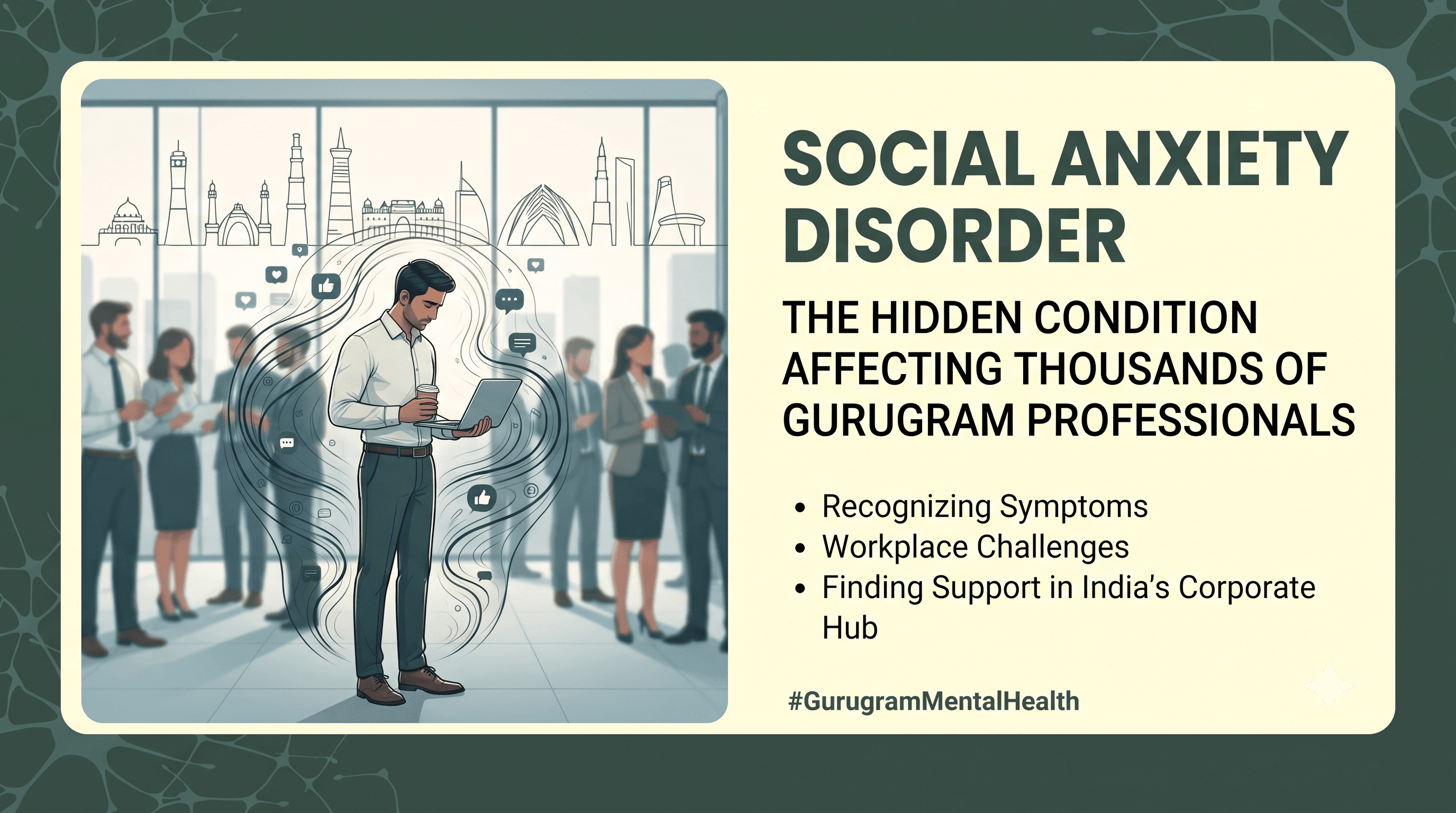
In a city built on networking, presentations, client relationships, and high-visibility professional performance, social anxiety disorder is one of the cruelest conditions a Gurugram professional can face. Unlike anxiety about a specific high-stakes situation — which virtually everyone experiences — social anxiety disorder is a persistent, pervasive, and disproportionate fear of social situations in which the person might be scrutinized, judged, evaluated, or embarrassed. And unlike introversion, which is a personality trait, social anxiety disorder is a clinical condition that causes genuine impairment and significant suffering.
What Social Anxiety Disorder Actually Is
Social Anxiety Disorder (SAD), also known as social phobia, is the third most common mental health condition globally, and one of the most consistently undertreated. It involves intense fear and anxiety in social situations where the person fears they will act in a way that will be judged negatively — performing poorly, appearing incompetent, saying something embarrassing, being visibly anxious, or otherwise failing to meet an imagined standard of social performance.
The critical feature that distinguishes SAD from ordinary social nervousness is the degree of impairment and distress. In SAD, the fear is recognized as excessive by the person themselves, but they cannot control it through reasoning. The physiological response — racing heart, flushing, sweating, trembling, voice changes — is real and often triggers a secondary spiral of anxiety about being visibly anxious, compounding the original fear.
Avoidance of feared social situations is the natural response to social anxiety, but it is the avoidance that sustains and expands the disorder over time. The more situations are avoided, the more confirmation the brain receives that these situations are dangerous, and the broader the avoidance grows.
How Social Anxiety Shows Up in Gurugram's Professional World
The manifestations of social anxiety in a corporate professional setting are specific and recognizable. Fear of speaking in meetings, particularly when a person feels evaluated by senior colleagues. Dread of presentations — sometimes so severe that opportunities for career advancement are declined rather than face the required speaking exposure. Difficulty in networking events where the expectation of small talk and social fluency feels impossible. Avoidance of client calls or video meetings. Difficulty eating in the company cafeteria or at business lunches due to fear of visible awkwardness.
What makes social anxiety particularly challenging in a professional context is the degree to which the corporate world is structured around precisely the activities that social anxiety makes most difficult. Meetings, presentations, social events, performance evaluations, and networking are not peripheral to professional success in Gurugram — they are central to it. This means social anxiety creates not just personal suffering but measurable career limitation.
Many people with social anxiety develop sophisticated avoidance and compensation strategies — preparing obsessively for presentations to reduce their uncertainty, positioning themselves near exits at social events, using alcohol to reduce social inhibition (a pattern that can develop into alcohol dependence), or building careers specifically around roles with minimal social exposure. These compensations allow functioning but at significant cost.
Social Anxiety vs Introversion vs Shyness
These three concepts are frequently confused, and the confusion matters for help-seeking. Introversion is a personality trait — a preference for less stimulating social environments and internal processing. Introverts can be perfectly comfortable in social situations; they simply find them draining rather than energizing. Introversion doesn't produce the intense fear, physiological reactivity, or functional impairment that characterizes social anxiety.
Shyness is a personality characteristic involving social inhibition and discomfort that exists on a continuum — mild shyness is common and doesn't necessarily impair functioning. Social anxiety disorder exists at the severe end where distress and functional impairment are significant. The distinction is clinical but also practically important: introversion and mild shyness don't require treatment, while social anxiety disorder benefits greatly from it.
Evidence-Based Treatment for Social Anxiety
Cognitive Behavioral Therapy is the most effective psychological treatment for social anxiety disorder, with a strong evidence base developed over decades. CBT for social anxiety focuses specifically on identifying and challenging the cognitive distortions driving the fear — the tendency to overestimate the probability and severity of negative evaluation, the self-focused attention that increases visible anxiety, and the post-event processing that replays perceived social failures after the fact.
The behavioral component of CBT for social anxiety — gradual, systematic exposure to feared social situations without avoidance — is the most powerful mechanism of change. Each successful navigation of a feared situation without avoidance provides direct experiential disconfirmation of the feared outcome, gradually reducing the strength of the threat signal the brain generates in that situation.
SSRIs and SNRIs have demonstrated efficacy for social anxiety disorder and are often used alongside CBT for moderate to severe presentations. For patients with treatment-resistant social anxiety — who have tried medication and adequate CBT without sufficient improvement — Deep TMS therapy offers a neurological approach that directly modulates the prefrontal-amygdala circuits underlying excessive fear response, with emerging evidence for effectiveness in social anxiety.
The Specific Challenge of Seeking Help With Social Anxiety
There is a bitter irony in the fact that one of the main barriers to treatment for social anxiety is the condition itself. Making an appointment, telling a receptionist why you're there, sitting in a waiting room with strangers, and then talking to an unfamiliar clinician about deeply private fears involves precisely the socially evaluative situations that social anxiety makes most difficult. Many people with social anxiety delay treatment for years not because they don't want help, but because the act of seeking it feels as frightening as what they're seeking help for.
Understanding this, Positive Mind Care, Gurugram, maintains an environment specifically designed to reduce the barriers for anxious patients — a calm, non-judgmental clinical environment with clear processes, privacy, and clinicians experienced in working at the patient's pace.
Social Anxiety and Technology: The Double-Edged Digital World
Technology has created a genuinely paradoxical environment for people with social anxiety. On one hand, digital communication — texting, email, messaging apps — provides lower-stakes alternatives to face-to-face interaction that many people with social anxiety find significantly less threatening, allowing participation in relationships and work that in-person demands would have excluded them from. Remote work, for those it's available to, has provided a professionally viable way of contributing without daily navigation of the office social environment.
On the other hand, social media creates new forms of social comparison, visibility, and evaluation that social anxiety attaches to with the same intensity as real-world social scrutiny. The number of likes on a post, the impression created by a LinkedIn update, or the sense that one's professional profile is being assessed and found wanting can generate genuine social anxiety in the digital domain. Managing social anxiety in the contemporary Gurugram professional environment therefore requires engagement with both traditional and digital social contexts — something that specialist treatment at clinics like Positive Mind Care addresses as part of comprehensive social anxiety care.
Frequently Asked Questions
Q1. Is social anxiety the same as being shy? No. Shyness is a common personality trait, while social anxiety disorder is a clinical condition causing significant distress and functional impairment that responds to specific treatment.
Q2. Can social anxiety improve without treatment? Social anxiety can reduce with life experience and gradual exposure, but moderate to severe social anxiety rarely resolves fully without structured treatment.
Q3. Will treatment change my personality? No. Treatment for social anxiety aims to remove the fear and avoidance that are limiting you — not to change your fundamental personality or make you someone you're not.
Q4. How long does treatment for social anxiety take? CBT for social anxiety typically runs 12-20 sessions, with meaningful improvement often visible within 8-12 weeks. Outcomes are generally good with appropriate treatment.
Conclusion
Social anxiety disorder is neither shyness nor a personality limitation — it is a well-understood clinical condition with highly effective treatments available in Gurugram. For any professional whose fear of social judgment is limiting their career, their relationships, or simply their daily quality of life, proper treatment can genuinely transform their experience. Positive Mind Care provides specialist assessment and treatment for social anxiety that is delivered with the understanding of how much courage it takes to reach out.