Relationships are the single most consistent predictor of human wellbeing — more strongly associated with happiness, health, and longevity than income, career success, or almost any other life variable. Yet in Gurugram's fast-paced professional world, relationships are often the first thing to suffer when pressure increases — and the last thing people seek formal help for, because doing so requires admitting difficulty in what is supposed to be the most private and intimate domain of life.
Relationship and marriage counselling has a significant evidence base and helps couples navigate difficulties ranging from communication breakdown and conflict patterns to infidelity recovery, sexual difficulties, parenting disagreements, and the corrosive effect that individual mental health conditions — depression, anxiety, ADHD — have on partnership dynamics. This blog examines when couples counselling is indicated, what it involves, and why seeking it earlier rather than later consistently produces better outcomes.
The Relationship Pressures Specific to Gurugram
Several features of life in Gurugram create relationship pressures that are quantifiably greater than in many other contexts. Dual-career couples — extremely common in Gurugram's professional community — face the particular challenge of managing two demanding careers while also managing a household, often without nearby extended family support, frequently having relocated from cities where their social networks were stronger. The coordination demands are high, the time for genuine connection is limited, and the potential for both partners to feel unseen and unsupported is correspondingly elevated.
Financial pressure, despite high household incomes in many cases, is paradoxically common due to Gurugram's high cost of living, large mortgages or rents, car loans, and the social pressure to maintain visible consumption standards. Financial disagreements are one of the most common presenting issues in couples therapy, and they are almost never really about money — they are about different values, different fears, and different assumptions about security and lifestyle that were never fully negotiated.
The absence of extended family proximity creates particular vulnerability for new parents. When there is no parental or in-law support nearby to share the load of new parenthood, the exhaustion and role disruption of having a baby falls exclusively on the couple — and this is statistically one of the highest-risk periods for relationship satisfaction decline. The Gurugram nuclear family model creates exactly this high-risk context for most new parents.
Signs That Counselling Would Help
Many couples wait until a relationship crisis — an affair, a serious confrontation, a near-separation — before seeking counselling, when the research consistently shows that earlier intervention produces better outcomes. There are several signs that professional support would be valuable well before a crisis point.
Communication has broken down in ways that feel repetitive and irresolvable — the same arguments cycling through without resolution, one or both partners feeling persistently unheard, or a progressive emotional distancing where important things simply aren't discussed any more. Contempt — eye-rolling, dismissiveness, sarcasm about the partner — is one of the most reliable predictors of relationship deterioration and warrants early intervention.
One or both partners is living with a mental health condition — depression, anxiety, ADHD, or trauma — that is directly affecting the relationship, and the couple hasn't found a way to navigate it together. Major life transitions — a new baby, a career change, bereavement, a relocation, a serious illness — are predictably destabilizing periods where therapeutic support helps couples adapt together rather than apart.
Sexual dissatisfaction or mismatch, when it is causing distress or distance, is a legitimate and common reason to seek counselling. This remains one of the most under-discussed and under-treated relationship issues in India due to cultural discomfort, yet it responds well to appropriate clinical support.
What Couples Counselling Actually Involves
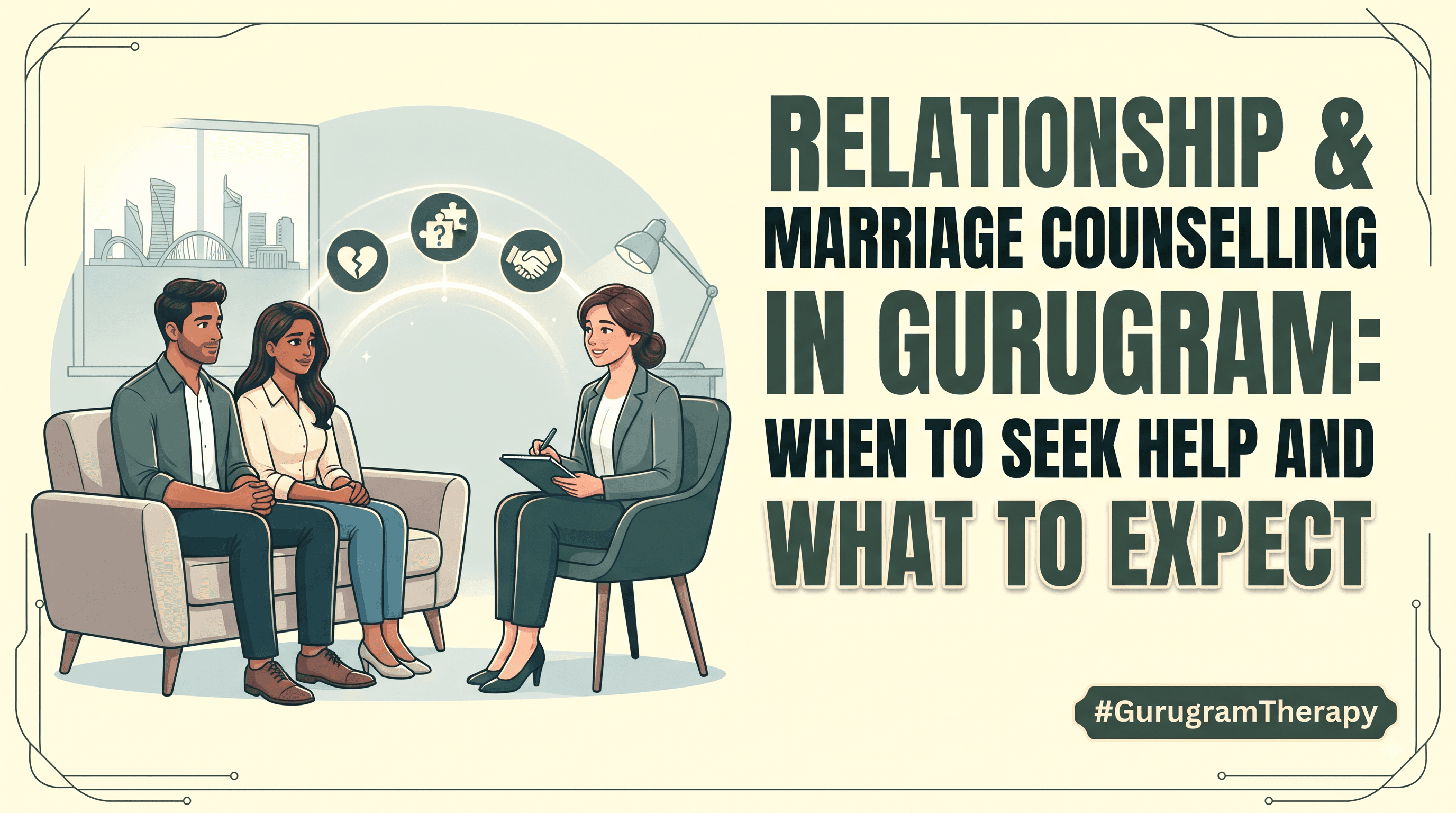
Couples therapy is not an arbitration — it is not about determining who is right and who is wrong, and a good couples therapist doesn't take sides. It is a facilitated process in which the couple, guided by a trained therapist, examines their interaction patterns, communication styles, underlying needs and expectations, and the dynamics that create their recurring difficulties.
Empirically-supported approaches include the Gottman Method, which is built on decades of relationship research and identifies specific communication and conflict resolution skills that distinguish stable from deteriorating relationships. Emotionally Focused Therapy (EFT) works at the level of attachment needs — helping partners understand and communicate the underlying emotional vulnerabilities that their arguments are actually about. Cognitive-Behavioral Couples Therapy identifies and modifies the cognitive distortions and behavioral patterns that sustain relationship conflict.
Sessions typically involve the couple together, with occasional individual sessions when needed. A common course runs 12-20 sessions, though some couples benefit from shorter or longer engagement.
The Role of Individual Mental Health in Relationship Health
One often overlooked dimension of relationship difficulty is the role of individual mental health conditions. Depression significantly reduces empathy, energy, and sexual interest — all of which affect partnership satisfaction. ADHD creates genuine difficulty with the reliability, follow-through, and emotional regulation that relationships require. Anxiety can produce controlling behavior, reassurance-seeking, or avoidance that strains the relationship over time. Untreated trauma shapes attachment patterns in ways that create predictable relationship dynamics.
When individual mental health conditions are significantly contributing to relationship difficulties, the most effective approach involves addressing both simultaneously — couples counselling alongside individual treatment for the relevant condition, which may include medication, therapy, or where indicated, Deep TMS therapy for depression or anxiety. Positive Mind Care, Gurugram, is positioned to provide this integrated approach, with capacity to assess both the relational and individual dimensions and provide coordinated treatment.
When to Seek Individual Versus Couples Support
Not every relationship difficulty warrants couples therapy as the starting point. When one partner is experiencing a significant individual mental health condition — moderate to severe depression, PTSD, active addiction — individual treatment often needs to be the priority, with couples counselling following once individual stability is established. Active domestic violence requires safety planning before any couples work — couples therapy is contraindicated while coercion or violence is ongoing. In these cases, individual therapy for the affected partner and clear safety support is the appropriate first response.
Frequently Asked Questions
Q1. Does seeking couples counselling mean the relationship is failing? No — it means the couple is taking their relationship seriously enough to invest in it. Couples who seek counselling before reaching crisis point generally have better outcomes than those who wait until they're on the verge of separation.
Q2. What if my partner refuses to come to counselling? Individual therapy can still be valuable — understanding your own patterns and improving your communication approach benefits the relationship even without your partner's direct participation.
Q3. Is marriage counselling confidential? Yes, sessions are confidential within the same clinical framework as individual therapy, with the therapist maintaining appropriate boundaries around what is shared between individual and joint sessions.
Q4. Where is couples counselling available in Gurugram? Positive Mind Care, Gurugram, provides relationship and marriage counselling alongside its broader mental health services, with clinicians experienced in the specific relationship dynamics of Gurugram's professional community.
Conclusion
Seeking relationship counselling is not a sign of failure — it is an investment in the most important determinant of your wellbeing and your family's stability. In Gurugram, where professional demands routinely compete with relationship investment, couples who proactively seek support when they notice difficulties consistently fare better than those who wait for crisis. Positive Mind Care offers professional, evidence-based couples support in a confidential and genuinely supportive clinical environment.