Post-Traumatic Stress Disorder is a condition that most people associate with war veterans — soldiers returning from combat zones with nightmares, flashbacks, and an inability to re-enter normal life. This association, while not entirely wrong, has done an enormous disservice to the millions of people across India who are living with PTSD from very different sources of trauma: road accidents, sexual assault, domestic violence, childhood abuse, medical emergencies, sudden bereavement, natural disasters, or the chronic, cumulative trauma of witnessing or experiencing sustained harm.
In Gurugram specifically, PTSD presents in contexts that are often invisible: the accident survivor who can't drive again, the sexual harassment victim who can't re-enter a professional environment, the child abuse survivor who has rebuilt an adult life around avoidance of the memories that keep breaking through, or the frontline worker who witnessed overwhelming suffering during the COVID pandemic. This blog examines PTSD comprehensively — its mechanisms, its presentations, and the modern treatments, including advanced Deep TMS therapy, now available in Gurugram to help trauma survivors genuinely heal.
What Is PTSD? The Neurological Reality of Trauma
PTSD is not simply being "unable to get over" a bad experience. It is a neurologically demonstrable condition in which the brain's normal memory processing system fails to consolidate a traumatic event into ordinary autobiographical memory — instead leaving it in a raw, unprocessed state that continues to generate the same overwhelming biological fear response every time it is activated, regardless of how much time has passed.
The brain regions most centrally involved in PTSD are the amygdala, which becomes hyperreactive and generates excessive fear responses, and the prefrontal cortex, which normally modulates these responses but becomes underactive in PTSD. The hippocampus, which helps contextualize memories in time and space, is also affected, which helps explain why PTSD memories feel so immediate and present rather than past.
This neurological basis means PTSD is not a weakness of character or a choice to dwell on trauma. It is a biological injury to the brain's threat-processing system that requires specific, evidence-based treatment to resolve.
How PTSD Presents: Going Beyond Flashbacks
The classic PTSD symptom cluster — vivid flashbacks and nightmares — is real, but it captures only part of how PTSD manifests. Re-experiencing symptoms include intrusive memories, nightmares, emotional flooding when exposed to trauma reminders, and physiological reactions to cues associated with the trauma.
Avoidance symptoms include deliberately avoiding any thoughts, feelings, people, places, or activities that trigger trauma memories. This avoidance is what makes PTSD so life-restricting — the person progressively builds their entire life around avoiding reminders, which can prevent them from working, socializing, or even leaving their home in severe cases.
Hyperarousal symptoms include a persistent state of heightened alertness, exaggerated startle response, sleep disturbance, irritability, anger outbursts, and difficulty concentrating. This physiological hypervigilance is exhausting and reflects the nervous system's inability to return to a baseline sense of safety after trauma.
Negative cognition and mood symptoms include persistent distorted beliefs about oneself ("I deserved it," "I am permanently damaged"), persistent negative emotions, diminished interest in activities, feelings of detachment from others, and inability to experience positive emotions. These cognitive-emotional symptoms are often the most chronically impairing.
PTSD in Gurugram: Sources Often Overlooked
While military trauma rarely features in Gurugram's context, road traffic accidents are one of the most common trauma sources in India's high-accident-rate environment. Gurugram's highways see a significant number of serious accidents each year, and many survivors develop significant PTSD that is rarely identified because physical injury treatment dominates the medical response with no psychiatric follow-up.
Workplace trauma — including sexual harassment, which remains underreported in corporate India despite regulatory frameworks — creates PTSD in significant numbers of professionals who leave their careers or entire professional sectors rather than return to environments associated with their trauma. Medical trauma — including difficult childbirth, sudden critical illness, or distressing medical procedures — is also a frequently overlooked source of PTSD in India.
Trauma-Focused Treatment: The Evidence-Based Options
Several therapies have strong evidence specifically for PTSD. Trauma-Focused Cognitive Behavioral Therapy (TF-CBT) involves graduated engagement with trauma memories in a controlled therapeutic environment, systematic cognitive processing of distorted trauma-related beliefs, and coping skill development. EMDR (Eye Movement Desensitization and Reprocessing) uses bilateral sensory stimulation while the patient engages with trauma material, facilitating the natural information processing that PTSD has disrupted. Both approaches require specialist training to deliver effectively.
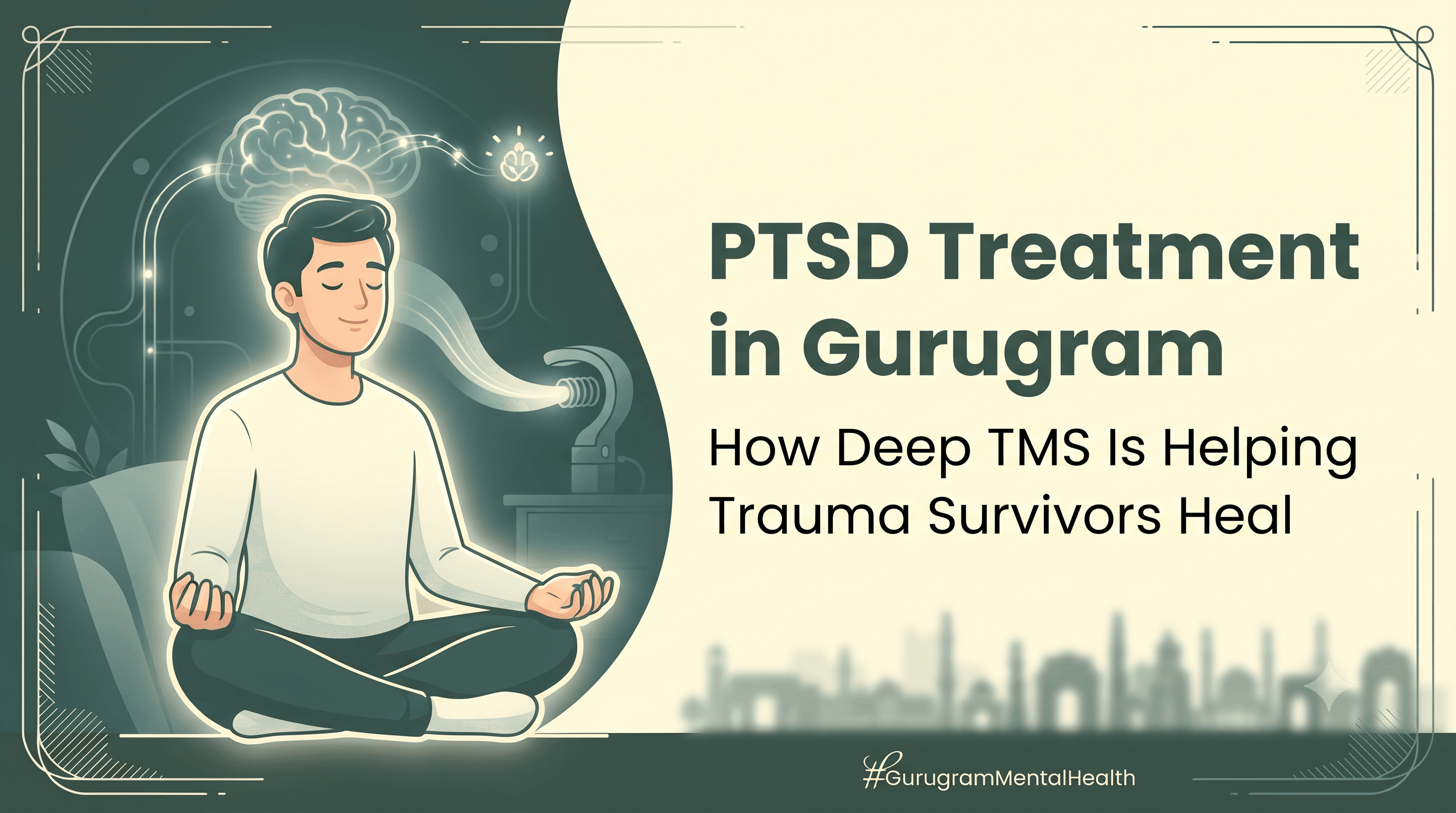
For patients who cannot engage adequately with trauma-focused therapy due to symptom severity, or for whom trauma therapy has been only partially effective, Deep TMS represents a significant advance. By directly modulating the amygdala hyperreactivity and prefrontal underactivity that characterize PTSD's neurological profile, Deep TMS can reduce the intensity of trauma responses enough to make trauma-focused therapy genuinely accessible — and for some patients, produces significant symptom reduction in its own right.
Why PTSD Is Chronically Undertreated in India
Several factors combine to make PTSD particularly undertreated in India. The condition is not widely recognized in primary care or general medical settings — patients presenting with hyperarousal, sleep disturbance, and emotional dysregulation may receive treatment for anxiety, insomnia, or depression without the traumatic root being identified. Cultural attitudes toward trauma — particularly around sexual or interpersonal violence — create powerful shame barriers to disclosure.
In Gurugram's professional context, there is also the perception that acknowledging the impact of a traumatic experience is incompatible with professional resilience and strength — a cultural script that keeps many trauma survivors silent and untreated for years.
The Importance of a Trauma-Informed Approach
Effective PTSD treatment requires not just specific therapeutic techniques but a trauma-informed clinical approach that prioritizes safety, trust, and control for the patient throughout the treatment process. At Positive Mind Care, Gurugram, this means assessment is paced to the patient's readiness, disclosures are met with appropriate clinical validation rather than clinical distancing, and treatment choices are collaborative rather than prescriptive.
The Invisible Survivors: PTSD After Workplace and Financial Trauma
Trauma doesn't require a dramatic event chronic, cumulative workplace trauma can produce a PTSD-like presentation that is rarely identified because it doesn't fit the classic war-veteran narrative. Sustained workplace bullying, repeated public humiliation by a manager, witnessing workplace violence, or the grinding anxiety of chronic job insecurity can all create lasting neurological imprints. Financial trauma losing significant savings, experiencing sudden bankruptcy, or facing debt collectors — is another commonly overlooked trauma source that affects increasing numbers of professionals in Gurugram's volatile economic landscape.
These forms of trauma deserve the same clinical seriousness as more widely recognized trauma sources. People affected by them are frequently told they're overreacting or being too sensitive, which adds a layer of invalidation to the trauma itself. At Positive Mind Care, Gurugram, all forms of trauma — whatever their origin — are assessed and treated with equal clinical rigor and without minimization.
Frequently Asked Questions
Q1. How long does PTSD treatment take? Active trauma-focused therapy typically runs 12-20 sessions. Deep TMS for PTSD runs 4-6 weeks. Many patients see meaningful improvement within 8-12 weeks of starting proper treatment.
Q2. Can PTSD go away without treatment? PTSD sometimes reduces over time, but more severe presentations rarely resolve fully without treatment, and the avoidance behaviors that develop can become deeply entrenched without clinical intervention.
Q3. Is it safe to talk about trauma in therapy? With a trauma-trained therapist, yes. Evidence-based trauma therapy is paced to your readiness and builds safety before engaging trauma material directly.
Q4. Is Deep TMS available for PTSD patients in Gurugram? Yes. Positive Mind Care, Gurugram, provides Deep TMS alongside trauma-focused therapy as part of an integrated PTSD treatment program.
Conclusion
PTSD is a neurological injury, not a character weakness, and it deserves the same clinical seriousness as any other brain condition. Modern treatments — trauma-focused therapy, EMDR, and advanced Deep TMS — have transformed the prognosis for PTSD when applied correctly. In Gurugram, these treatments are now accessible for trauma survivors of every kind. If you are living with unaddressed trauma, professional help is available and it genuinely works.