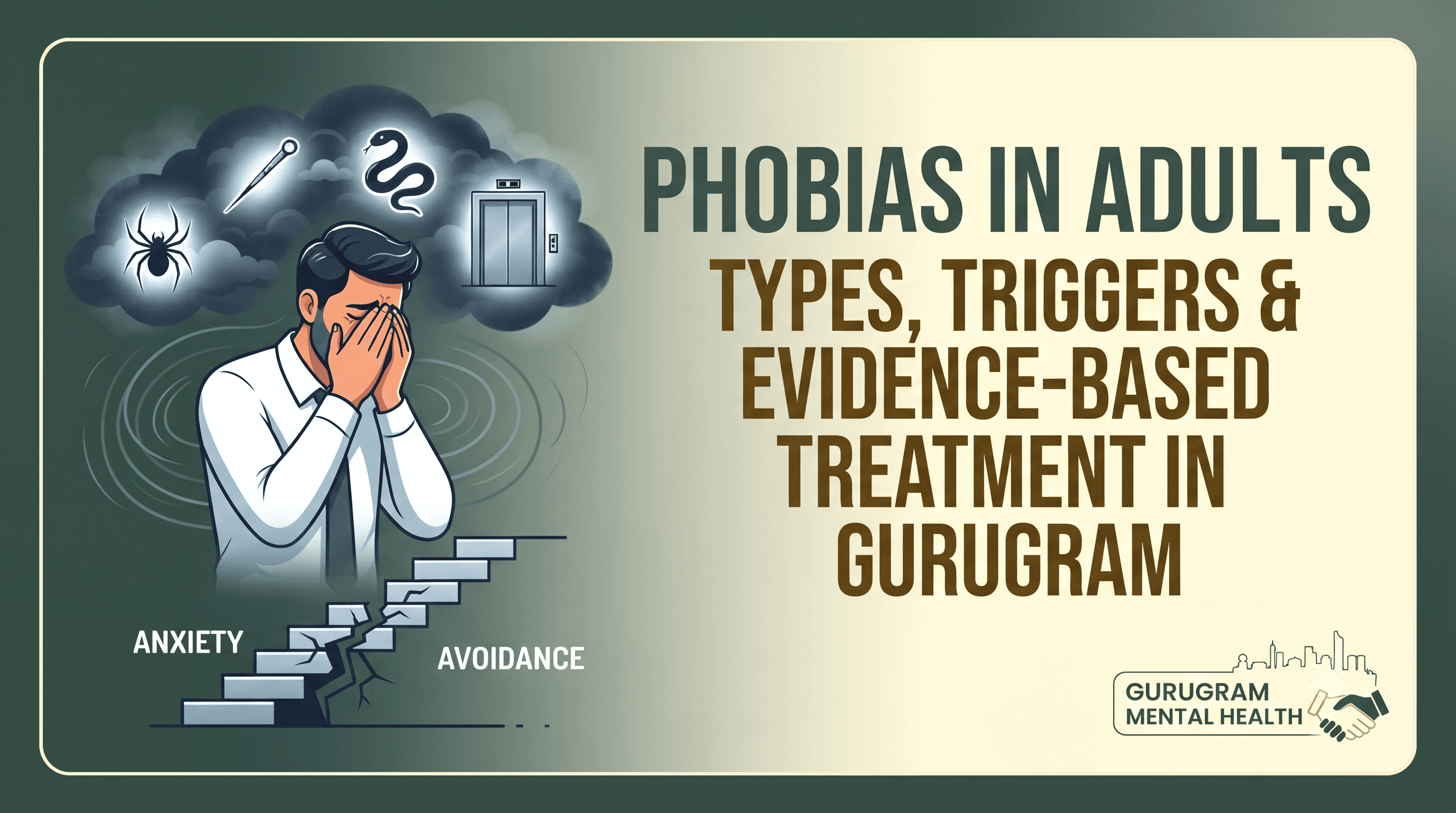
A phobia is more than strong dislike or ordinary fear — it is an intense, persistent, and disproportionate fear of a specific object, situation, or experience that causes the person to go to significant lengths to avoid it, often at considerable personal cost. Phobias are among the most prevalent of all anxiety conditions, yet they are also among the most undertreated, partly because many people learn to build their lives around their phobias without seeking help, and partly because the treatment — while highly effective — requires a period of deliberate discomfort that many people prefer to postpone indefinitely.
This blog examines the major types of phobia seen in adults, explains the neurological basis of phobic fear, and outlines the evidence-based treatment approaches now available in Gurugram that can resolve phobias more effectively and more quickly than most people realize.
The Neurological Basis of Phobia
Phobias, like all anxiety conditions, involve an overactive threat response in the amygdala the brain's fear center that has become specifically calibrated to a particular trigger. Through a combination of direct negative experience, observational learning, or in some cases without any identifiable origin, the brain has learned to classify a specific object or situation as intensely dangerous and generates a full fear response upon contact with it.
This response rapid heart rate, difficulty breathing, trembling, sweating, dizziness, and an overwhelming urge to escape is identical to the response that would be generated by a genuine life threat. From the amygdala's perspective, the phobic trigger is as real a danger as an oncoming vehicle. Understanding this helps contextualize why reasoning one's way out of a phobia doesn't work the threat response is generated in brain regions that operate faster than conscious reasoning and aren't accessible to logical argument.
Types of Specific Phobia
Specific phobias are typically grouped into a few major categories, though the actual range of possible phobic triggers is essentially unlimited. Animal phobias particularly dogs, snakes, spiders, and insects are among the most common and often have early childhood origins. Natural environment phobias involve intense fear of heights (acrophobia), storms, water, or darkness. Blood-injection-injury phobia involves fear of blood, needles, medical procedures, or physical injury and is notable for its unique physiological response involving a drop in heart rate and blood pressure (rather than the typical increase) that can produce fainting.
Situational phobias include claustrophobia (enclosed spaces), aviophobia (flying), and driving phobia — all of which can significantly restrict mobility and lifestyle. For Gurugram's professionals, flying phobia is particularly impactful given the frequency of domestic and international business travel, and driving phobia following a road accident is another common presentation in a city with significant road trauma rates.
Agoraphobia: Often Misunderstood
Agoraphobia is frequently described simply as fear of open spaces, but this is an oversimplification. It is actually a fear of situations where escape would be difficult or help unavailable if a panic attack or severe anxiety occurred. Common agoraphobic situations include crowded places, public transport, being outside the home alone, standing in queues, and crossing bridges or being in open spaces.
Agoraphobia commonly develops as a secondary consequence of panic disorder, when the person begins avoiding the situations associated with previous panic attacks. It can become severely life-restricting some people with agoraphobia become effectively housebound, unable to engage with the outside world at all. This is a clinical emergency that warrants urgent psychiatric intervention.
How Exposure Therapy Works for Phobias
The most effective and well-evidenced treatment for specific phobias is Exposure Therapy a structured, gradual process of confronting the feared stimulus in a controlled, therapeutic context. Unlike simply being thrown into feared situations (flooding), modern exposure therapy uses a graduated hierarchy starting with the least anxiety-provoking encounters with the feared stimulus and systematically working up through more challenging exposures as the person's anxiety habituates at each level.
Each successful exposure remaining in contact with the feared stimulus long enough for anxiety to naturally reduce without escape or avoidance directly disconfirms the threat signal in the amygdala and begins to recalibrate the fear response. The treatment requires courage, but the results are typically rapid: specific phobias are among the most treatment-responsive of all anxiety conditions, with many patients achieving substantial improvement within 6-12 sessions.
Virtual Reality Exposure Therapy (VRET) is an emerging approach that allows exposure to be conducted in a virtual environment particularly valuable for phobias like flying, heights, or public speaking where real-world exposures are logistically difficult or expensive to arrange.
When Medication and Deep TMS Help
For phobias with a strong generalized anxiety component, or where the neurological fear response is so intense that the person cannot engage adequately with exposure at any level of the hierarchy, short-term anxiolytic support or Deep TMS therapy can provide the neurological foundation needed for exposure therapy to be tolerable and effective. Deep TMS directly reduces amygdala hyperreactivity and enhances prefrontal modulation of fear responses, potentially making the exposure process less overwhelming for patients with severe presentations.
Phobias in the Workplace: Career Impact and Specific Considerations
Several phobia types have specific workplace implications worth addressing directly. Flying phobia is career-limiting in any role that requires business travel and Gurugram's global-facing corporate sector involves significant domestic and international travel for many professionals. Elevator phobia or claustrophobia creates genuine difficulty in a city of high-rise offices where elevator use is unavoidable. Driving phobia following a road accident can prevent professionals from returning to their normal commute. Vomit phobia (emetophobia) may affect food-related workplace situations.
For each of these, exposure therapy specifically designed around the functional goals of the individual's professional life can provide targeted relief. A professional whose career requires flying can undergo a focused course of flying-specific CBT and exposure that directly addresses the specific fear with the specific professional context in mind, producing treatment outcomes measured in career terms as much as clinical ones.
Frequently Asked Questions
Q1. Can a phobia developed in childhood be successfully treated in adulthood? Yes. The duration of a phobia doesn't significantly reduce the effectiveness of exposure therapy. Many adults successfully treat phobias they have carried since childhood.
Q2. How many sessions does phobia treatment take? Specific phobias are often treated in as few as 6-12 sessions of focused exposure therapy, making them one of the most efficiently treatable anxiety conditions.
Q3. Will I have to do something terrifying during therapy? Exposure therapy is graduated you'll never be asked to do something you're not ready for. The therapist works with you to find a starting point that is manageable, and progresses at your pace.
Q4. Where can I get phobia treatment in Gurugram? Positive Mind Care, Gurugram, offers specialist phobia assessment and exposure therapy delivered by experienced clinicians, alongside psychiatric evaluation for any underlying anxiety condition.
Conclusion
Phobias are among the most treatable conditions in mental health, yet they're frequently carried for years or decades simply because people don't know that effective, relatively brief treatment is available. Whether your phobia involves animals, situations, medical procedures, heights, or any other stimulus, evidence-based treatment can free you from the avoidance and fear that your phobia currently demands. Positive Mind Care in Gurugram is equipped to help.