Introduction
Do you ever found yourself thinking the same thing over and over again? Or did you feel the need to repeatedly check if the door was locked even though you knew you had already done so? Obsessive-Compulsive Disorder (OCD) is a more serious condition that can be indicated by persistent, unwanted thoughts and a persistent need to repeat particular acts, even though occasional repetitive thoughts and habits are common.
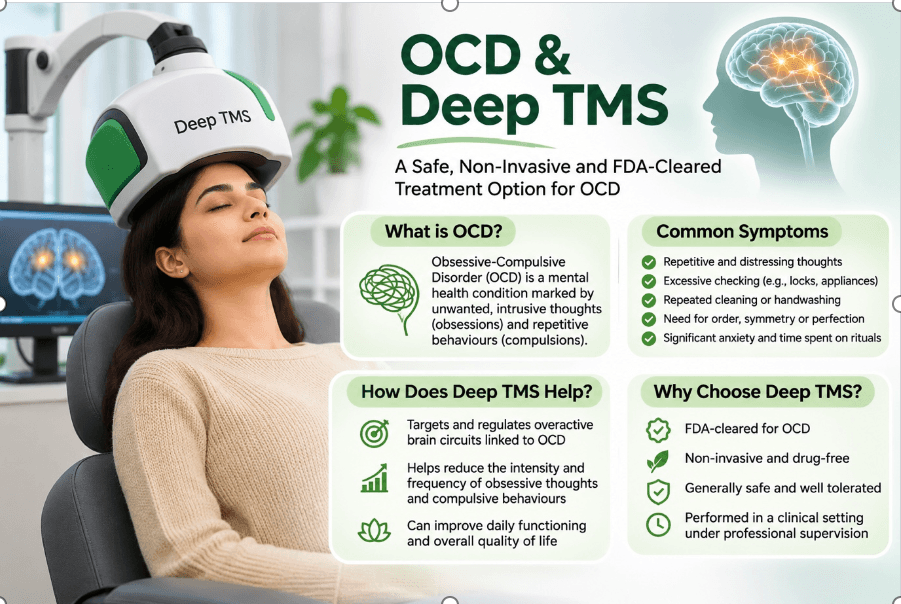
OCD is a mental health condition that can significantly affect an individual's thoughts, emotions, daily routine, relationships, professional life, and overall quality of life. Fortunately, advancements in mental health treatment are creating new possibilities for individuals living with OCD. One such advancement is Deep Transcranial Magnetic Stimulation (Deep TMS), a non-invasive, FDA-cleared treatment option for OCD that offers hope to individuals, particularly those who have not achieved sufficient improvement with conventional treatments.
What Is Obsessive-Compulsive Disorder (OCD)?
1. Obsessions
Obsessions are persistent, unwanted, and intrusive thoughts, images, or urges that create significant anxiety or distress.
Its examples are:
· Fear of germs, contamination, or infection.
· Repeated doubts about whether something has been done correctly.
· Unwanted aggressive or disturbing thoughts.
· Excessive concern about symmetry, order, or perfection.
· Fear of accidentally harming oneself or others.
What Causes OCD?
There is no single cause of OCD. Research suggests that several biological, psychological, and environmental factors may contribute to its development.
Some commonly recognised factors include:
· Brain functioning: Differences in brain circuits involved in habit formation, decision-making, and emotional regulation may contribute to OCD.
· Genetic factors: Individuals with a family history of OCD may have an increased likelihood of developing the condition.
· Neurobiological factors: Neurotransmitter systems, particularly serotonin, play an important role in OCD.
· Environmental influences: Stressful life experiences and certain environmental factors may contribute to the onset or worsening of symptoms.
It is important to understand that OCD is not a personality weakness, a lack of willpower, or simply a habit of being excessively organised.
Who Can We Consider Deep TMS for OCD?
Deep TMS may be considered for adults diagnosed with OCD, particularly those who have experienced inadequate improvement with conventional treatment.
It may be an option for individuals who:
· Continue to experience OCD symptoms despite medication.
· Have not achieved sufficient improvement through psychotherapy.
· Experience significant interference with everyday activities.
· Are looking for an additional evidence-based treatment option.
However, Deep TMS is not suitable for everyone. A detailed psychiatric assessment is necessary to determine eligibility, treatment suitability, and potential risks.
Is Deep TMS Safe?
Yes it is generally considered a well-tolerated, non-invasive treatment when administered by trained professionals.
Deep TMS: A New Direction in OCD Treatment
The introduction of Deep TMS represents an important advancement in the field of neuromodulation.
For individuals who continue to struggle with intrusive thoughts, repetitive behaviours, and persistent anxiety despite conventional interventions, Deep TMS offers another treatment option worth discussing with a qualified psychiatrist.
It is important to remember that Deep TMS is not a guaranteed cure for OCD. Treatment outcomes vary, and it may be recommended alongside other evidence-based interventions.
The Importance of Early Diagnosis and Professional Support
OCD is more than excessive cleanliness, perfectionism, or repetitive habits. It is a recognised mental health condition that deserves appropriate diagnosis, understanding, and treatment.
Unfortunately, stigma and misconceptions often prevent individuals from seeking professional help.
Recognising symptoms early, consulting a qualified mental health professional, and exploring appropriate treatment options can help individuals regain control over their everyday lives.
Conclusion
Living with OCD can be emotionally exhausting, but it does not have to define a person's life. With advancements in psychotherapy, psychiatric medication, and neuromodulation, individuals now have access to a wider range of treatment options. Deep TMS offers a promising, non-invasive, evidence-based option for certain individuals with OCD, particularly those who have not responded adequately to conventional treatments.