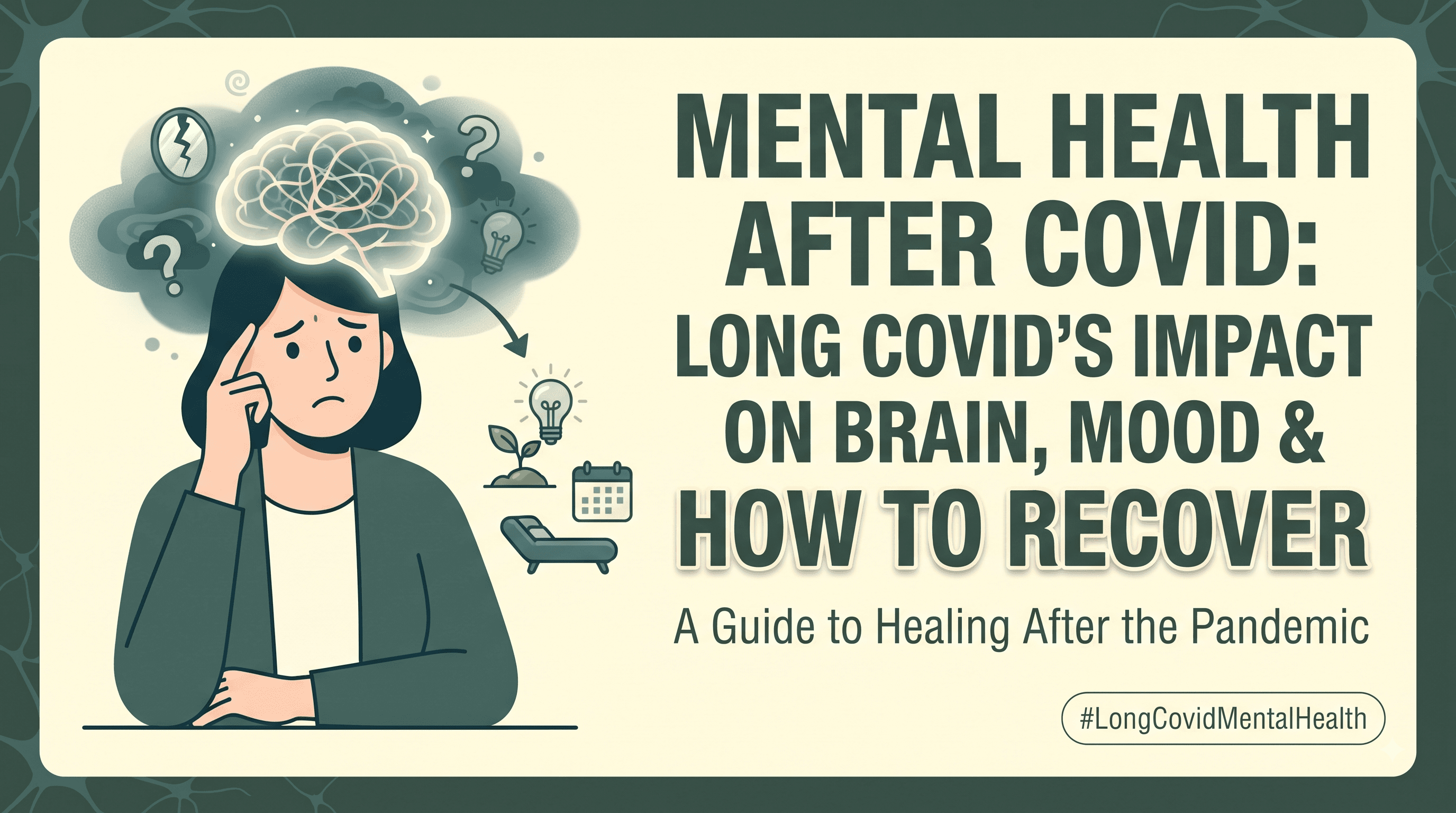
The COVID-19 pandemic ended as a public health emergency in 2023, but its neuropsychiatric legacy continues to manifest in clinics across Gurugram and Delhi-NCR. Long COVID — the persistence of symptoms beyond the acute infection phase — has documented effects on the brain that produce a distinctive cluster of psychiatric and cognitive symptoms affecting thousands of people who had COVID-19, sometimes even after mild initial infections. Understanding these effects, recognizing when they require professional mental health support, and knowing what treatments are available is essential for the many Gurugram residents still experiencing pandemic-era mental health consequences.
The Neuropsychiatric Burden of COVID-19
Research has clearly established that COVID-19 is not merely a respiratory illness — it has significant neurological effects in a substantial minority of those infected. The mechanisms appear to include direct viral neuroinvasion, systemic inflammation and its brain effects, disruption of cerebral blood flow and oxygenation, and — particularly relevant for psychiatric sequelae — dysregulation of neurotransmitter systems, particularly serotonin.
The psychiatric and cognitive consequences documented in Long COVID research include new-onset or worsened depression, anxiety disorders, PTSD (particularly following ICU stays or severe illness), cognitive impairment affecting memory and concentration (commonly called "brain fog"), and disrupted sleep. These conditions occur at rates significantly higher than in the general population and persist in many patients well beyond the expected viral clearance.
COVID Brain Fog: What It Is and Why It Happens
Brain fog is perhaps the most commonly reported and most poorly understood Long COVID symptom. Patients describe it as a persistent difficulty concentrating, slowed cognitive processing, word-finding difficulties, poor short-term memory, and a general sense that thinking requires far more effort than it did before COVID. These symptoms can be subtle enough to be dismissed as tiredness, but for many patients they significantly impair professional functioning.
The neurological basis involves multiple factors: neuroinflammation affects the prefrontal cortex and hippocampus — regions critical for executive function and memory. Disrupted sleep (itself a Long COVID consequence) compounds cognitive impairment. Anxiety and depression, also common in Long COVID, independently impair concentration and cognitive performance. For some patients, cardiovascular changes in Long COVID reduce cerebral blood flow in ways that affect cognitive function.
The Mental Health Consequences of the Pandemic Beyond Infection
Even setting aside direct neurological effects of COVID infection, the pandemic produced a mental health emergency through its psychosocial impacts. The years of social isolation, bereavement, disruption to normal life routines, economic uncertainty, and pervasive threat created ideal conditions for anxiety disorders, depression, grief, and trauma responses in people who were never infected at all.
For Gurugram professionals, the blurring of home and work that came with pandemic remote work created its own mental health consequences — loss of work-life separation, social disconnection from colleagues, the grief of disrupted career progression, and for many, the trauma of watching family members become seriously ill.
Long COVID and Its Interaction With Existing Mental Health Conditions
For people who had existing mental health conditions before COVID — depression, anxiety disorders, OCD — Long COVID frequently produced significant worsening. The neuroinflammatory mechanisms of Long COVID appear to exacerbate pre-existing neuropsychiatric vulnerabilities, and the disruption to sleep, routine, and social functioning created additional stressors that destabilized previously well-managed conditions.
Many people who had their anxiety or depression well-controlled before COVID have found that since infection, their medications are less effective, their symptoms more prominent, and their resilience reduced. This is a recognized clinical pattern and suggests that Long COVID may have genuinely shifted the neurobiological landscape for these patients, requiring treatment reassessment.
Deep TMS and Long COVID Mental Health
Deep TMS therapy is particularly relevant in the Long COVID mental health context for several reasons. First, it directly addresses the neurological component — the prefrontal hypoactivity and limbic hyperactivity associated with depression and anxiety — through direct brain circuit modulation, bypassing the systemic pathways affected by Long COVID's inflammatory mechanisms.
Second, for patients whose existing antidepressants have become less effective since COVID infection, Deep TMS offers an add-on treatment that works through a different mechanism and may achieve improvement where medication alone now falls short. At Positive Mind Care, Gurugram, patients presenting with worsened depression or anxiety following COVID infection are assessed for Long COVID's contribution to their clinical picture and treated with approaches that account for this, including Deep TMS where indicated.
Recovery: A Multidimensional Approach
Recovery from Long COVID mental health consequences requires attention across several dimensions simultaneously. Managing the psychiatric symptoms — depression, anxiety, trauma responses — through appropriate therapy and medication is the primary clinical focus. Addressing sleep disruption, which both results from and sustains psychiatric symptoms, is equally important. Graduated physical activity, paced carefully to avoid post-exertional malaise (a common Long COVID feature), supports both mood and cognitive recovery.
The Long-Term Neurological Legacy of COVID in India's Context
India experienced some of the highest COVID-19 case volumes globally, particularly during the devastating Delta wave in 2021, and the neuropsychiatric consequences of this scale of infection are significant at a population level. Many Gurugram residents experienced or witnessed extreme illness during this period, and for significant numbers, the psychological trauma of that experience — the fear, the loss, the helplessness — produced lasting mental health consequences.
Several factors specific to India's COVID experience compound these effects: the breakdown of healthcare access during peak waves, the inability to be with dying relatives due to infection control measures, the disproportionate burden on families who managed illness at home without adequate medical support, and the economic devastation for significant portions of the population. Clinicians in Gurugram are therefore seeing a population with a complex, multi-layered pandemic mental health legacy that requires sensitivity to these specific experiences alongside clinical precision in assessment and treatment. Recognizing this context and approaching post-COVID mental health with both clinical rigor and genuine empathy for what patients lived through is a defining feature of quality psychiatric care in this moment — and it is the approach that Positive Mind Care, Gurugram, is committed to in every consultation with patients navigating the lasting neuropsychiatric consequences of India's pandemic experience.
Frequently Asked Questions
Q1. How long do Long COVID psychiatric symptoms last? This is highly variable. Some patients recover within a few months, while others continue to experience significant symptoms for a year or more. Clinical treatment accelerates recovery compared to waiting without intervention.
Q2. Can people with Long COVID brain fog return to full cognitive function? Many do, particularly with appropriate treatment and lifestyle support. Complete recovery is achievable for most patients, though timelines vary.
Q3. Is Deep TMS safe for Long COVID patients? Yes. Deep TMS is non-invasive and doesn't interact with Long COVID's pathophysiology. It can be used alongside medical management of Long COVID symptoms.
Q4. Where can I get Long COVID mental health assessment in Gurugram? Positive Mind Care, Gurugram, provides psychiatric assessment and treatment for patients experiencing mental health consequences of COVID-19, including worsened mood disorders and cognitive difficulties.
Conclusion
Long COVID has left a neuropsychiatric legacy that deserves the same clinical seriousness as its physical consequences. If your mental health has not returned to its pre-COVID baseline, or if COVID has left you with new depression, anxiety, or cognitive difficulties, professional assessment and modern treatment — including Deep TMS — can make a meaningful difference in your recovery trajectory.