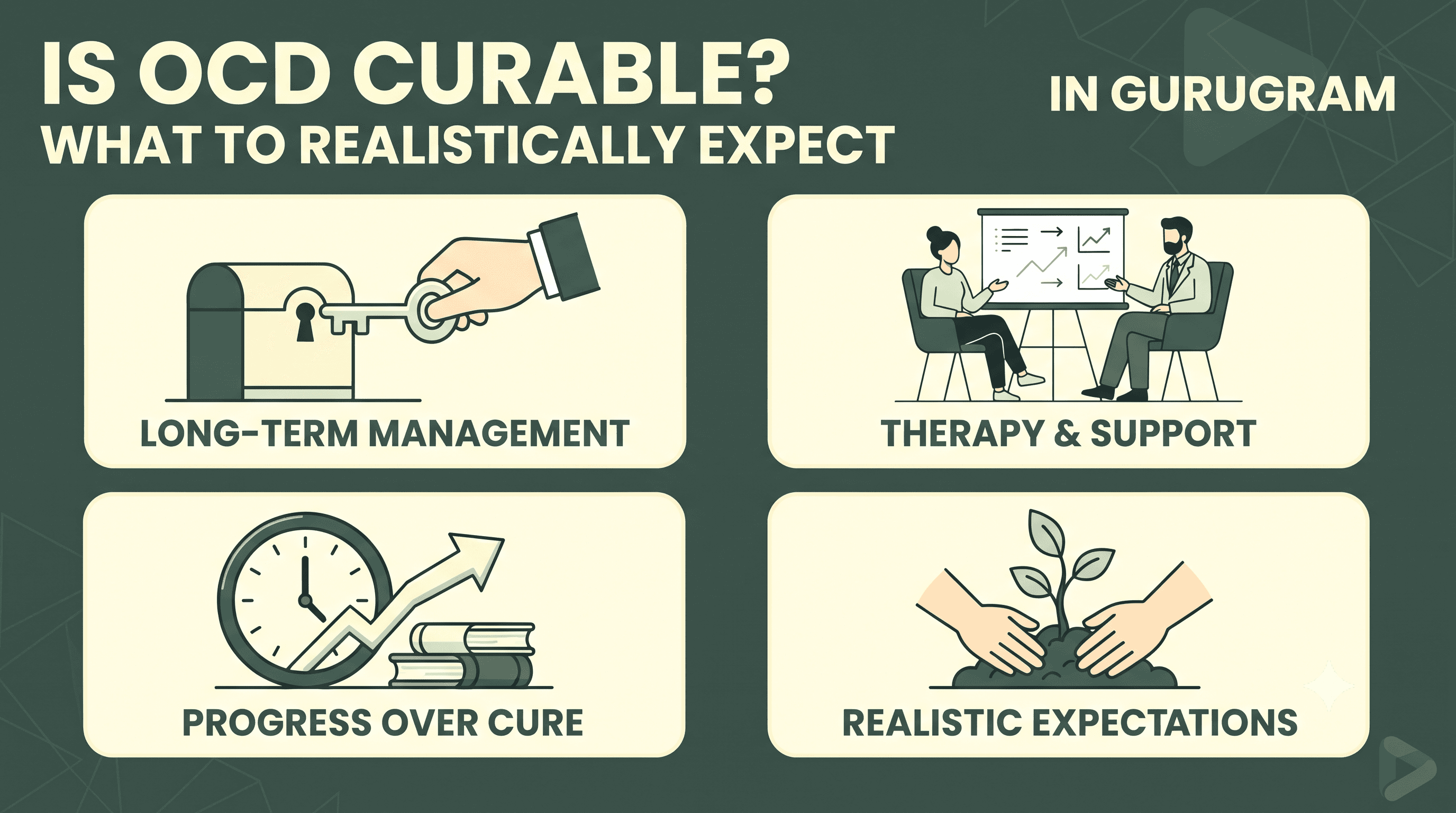
"Is OCD curable?" is one of the most common and most important questions that OCD patients ask when considering treatment. It's a question that deserves an honest, nuanced answer — not the unrealistic optimism that leaves people feeling like failures when symptoms don't disappear entirely, and not the unnecessary pessimism that discourages people from pursuing treatment at all. The reality of OCD recovery is genuinely encouraging, but it requires understanding what "recovery" in OCD actually means and what factors influence the path there.
What "Cured" Means — and Doesn't Mean — for OCD
In clinical terms, OCD is not typically described as "cured" the way a bacterial infection is cured by antibiotics. It is more accurately described as a condition that can be brought into sustained, functional remission — a state where symptoms are so reduced that they no longer significantly affect quality of life or daily functioning.
This distinction matters less than it might seem at first. Many people who complete comprehensive OCD treatment reach a point where intrusive thoughts occur rarely, feel much less distressing when they do occur, and no longer trigger compulsive rituals. They return to full-time work, maintain healthy relationships, and engage in activities they had previously avoided entirely. From any practical standpoint, this is recovery — even if it technically falls short of complete symptom elimination.
What the Evidence Actually Shows
The research on OCD treatment outcomes is genuinely encouraging. ERP therapy, the gold-standard psychological treatment for OCD, produces meaningful symptom reduction in roughly 60 to 80 percent of patients who complete an adequate course. SSRIs at appropriate doses add additional benefit for many patients. For the significant minority who don't respond adequately to ERP and medication, Deep TMS — now FDA-cleared specifically for OCD — has demonstrated clinically significant response rates even in this treatment-resistant group.
Long-term follow-up studies show that ERP gains tend to be durable — many patients maintain significant symptom improvement years after completing treatment, particularly those who continue applying ERP principles to new challenges that arise. This durability is meaningfully better than for medication alone, which provides symptom relief only while taken but doesn't necessarily produce lasting change in the underlying behavioral patterns.
Factors That Influence Recovery
Not every OCD patient's recovery journey is identical. Several factors influence treatment outcomes in ways that are worth understanding.
Treatment type and quality matters enormously. ERP delivered by a therapist without specific OCD expertise often produces poorer outcomes than ERP delivered by a clinician well-versed in OCD's specific mechanisms. Receiving generic CBT or anxiety counselling when you have OCD is not the same as receiving proper ERP therapy. This is one reason why clinic selection matters in Gurugram.
Engagement quality during ERP is perhaps the single most important predictor of outcome. ERP requires patients to actively tolerate anxiety without performing compulsions during exposures — patients who engage fully with this process, even when uncomfortable, consistently show better outcomes than those who partially comply or mentally "escape" during exposures.
Severity and duration of OCD at treatment onset also predict outcomes. Earlier treatment generally produces better and faster results. OCD that has been severe and untreated for many years has had more time to establish deeply reinforced neural patterns, though even long-standing OCD can still respond meaningfully to proper treatment.
The Role of Deep TMS in Improving Outcomes
For patients whose OCD hasn't responded adequately to ERP and medication alone, Deep TMS opens a new pathway. Rather than replacing ERP, Deep TMS works alongside it — by directly reducing the intensity of the overactive brain circuits driving OCD, it can make the ERP process more accessible for patients who previously found the anxiety during exposures overwhelming.
At Positive Mind Care, Gurugram, the integration of Deep TMS with an ongoing ERP protocol has helped patients who had previously seen limited progress make meaningful gains. The combination addresses OCD at both the neurological level (Deep TMS) and the behavioral level (ERP), producing more comprehensive and durable outcomes than either approach alone for this group.
Managing Setbacks During Recovery
Recovery from OCD is rarely a straight line upward. Most patients experience periods of improved symptom control interspersed with temporary worsening — particularly during periods of high stress, major life changes, illness, or sleep disruption. These setbacks are not failures, and they do not erase the progress made.
Patients who understand this trajectory in advance — who know to expect fluctuations without interpreting them as evidence that treatment isn't working — navigate setbacks much more effectively than those who are surprised by them. Experienced clinicians at clinics like Positive Mind Care prepare patients for this reality during the treatment planning process.
Life After OCD Treatment: A Realistic Picture
Patients who have completed comprehensive OCD treatment describe several common themes in their experience. Many describe no longer feeling controlled by their thoughts — while intrusive thoughts may still occasionally arise, they no longer feel as powerful or as demanding of a response. Compulsions that once consumed hours each day are reduced to minutes or eliminated entirely. Activities that were previously avoided — social situations, work tasks, physical locations — become accessible again.
Perhaps most valuably, people who have been through ERP and Deep TMS describe a fundamentally different relationship with their own minds. Rather than fearing intrusive thoughts as threats that require neutralizing, they have learned to relate to them as neurological noise — uncomfortable perhaps, but not meaningful, and not demanding of action.
Building an OCD Support Network
Recovery from OCD is substantially supported by having people around you who understand the condition accurately. Sharing accurate information about OCD with a trusted partner or family member can transform their response from frustration or inadvertent accommodation to genuine therapeutic support. Organizations like IOCDF (International OCD Foundation) provide accessible educational resources for patients and families.
Peer support also has a meaningful role — connecting with others who have experience of OCD recovery, whether through support groups or online communities, reduces the profound isolation that OCD creates and provides concrete, relatable evidence that recovery is genuinely possible. Some patients find that this peer connection is a powerful motivator for continuing treatment during its more challenging phases.
Frequently Asked Questions
Q1. Can OCD come back after successful treatment? OCD can relapse, particularly during high-stress periods. However, patients who have completed ERP retain the skills to manage recurrence, and additional booster sessions or a brief Deep TMS maintenance course can help restore control.
Q2. Should I expect a "quick fix" from Deep TMS? Deep TMS produces meaningful improvement for most OCD patients who complete the course, but it works best as part of a comprehensive treatment plan that includes ERP. It is not an instantaneous fix but a significant therapeutic tool.
Q3. How do I know if my OCD is getting better? Meaningful improvement typically shows as reduced time spent on compulsions, reduced intensity of obsessional distress, and increasing ability to engage in previously avoided activities.
Q4. Is maintaining improvement possible without continuing medication indefinitely? For many patients, particularly those who have done thorough ERP, medication can eventually be tapered with their psychiatrist's guidance. ERP skills, once learned, provide lasting benefit independently of medication.
Conclusion
OCD is not a life sentence. It is a treatable, manageable condition for which effective, evidence-based tools — including ERP, medication, and advanced Deep TMS — now exist in Gurugram. Recovery may not mean the permanent disappearance of every intrusive thought, but it genuinely can mean getting your life back, one choice at a time. If you're living with OCD in Gurugram, professional treatment at a specialized clinic is the most reliable path to that recovery.