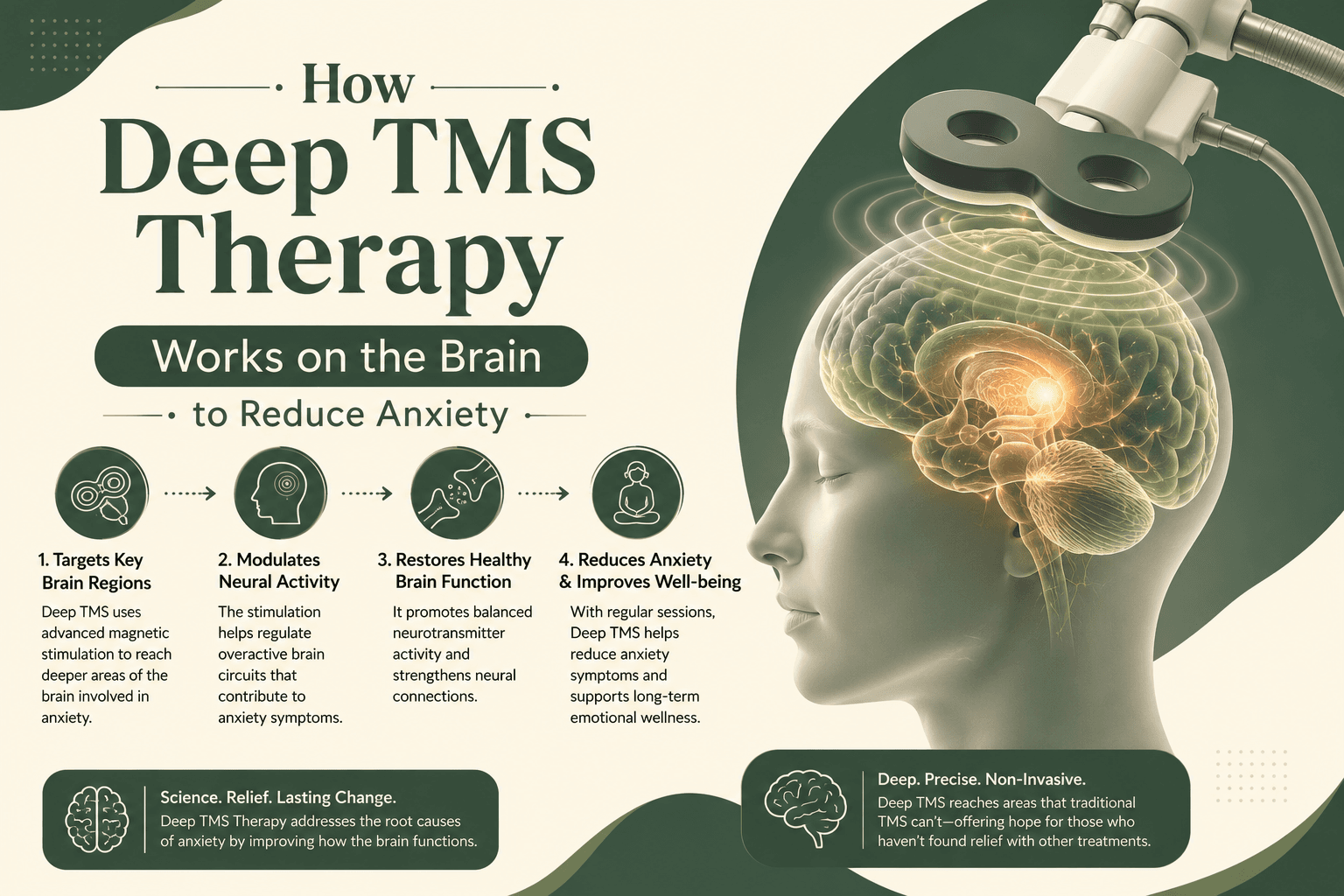
How Deep TMS Therapy Works on the Brain to Reduce Anxiety
To understand anxiety disorder, we first need to understand what's actually happening inside our brain during anxiety. Once we realize that anxiety is a neurological process, not just "weakness" or "overthinking," understanding the mechanism of Deep TMS Therapy also becomes much easier. In this blog, we'll go deeper into the science and understand exactly how Deep TMS reduces anxiety.
What Happens in the Brain During Anxiety
Our brain mainly uses two important areas to manage anxiety and fear response — the Amygdala and the Prefrontal Cortex. The Amygdala is the brain's "alarm system" that detects threats and triggers fear responses. The Prefrontal Cortex, located in the front part of the brain, is responsible for rational thinking and emotional regulation — basically, it works to "calm down" the amygdala.
In anxiety disorders, this balance gets disrupted. The amygdala becomes overactive and triggers a fear response even at the smallest things, treating them as threats. At the same time, Prefrontal Cortex activity decreases, making it unable to effectively control the amygdala. This is precisely the imbalance that becomes the root cause of persistent worry, panic attacks, and excessive fear.
Deep TMS's Targeting Mechanism
Deep TMS therapy uses specially designed H-Coil technology that can target deeper and wider neural networks in the brain compared to traditional TMS coils. When this coil is positioned on the patient's scalp, it generates controlled magnetic pulses that painlessly pass through the skull and reach the brain tissue.
These magnetic pulses work on the principle of electromagnetic induction — when the magnetic field changes, small electrical currents are induced in the brain tissue. These currents specifically activate or modulate neurons in the targeted brain region, such as the medial prefrontal cortex or anterior cingulate cortex, which are directly involved in mood and anxiety regulation.
Neuroplasticity: Reshaping the Brain
The real magic of Deep TMS lies in the concept of neuroplasticity. Neuroplasticity means our brain can form new neural connections and modify existing ones, even in adulthood. When Deep TMS sessions are given repeatedly — generally daily or every other day, over several weeks — these targeted brain circuits gradually start to strengthen or rebalance.
This improves the activity of the Prefrontal Cortex, which then better controls the Amygdala's overactive fear response. Over time, patients naturally experience a reduction in their anxiety, worry, and fear responses — without inducing chemical changes through any medication.
Stimulation Parameters and Personalization
An important technical aspect of Deep TMS treatment is the stimulation parameters — such as frequency, intensity, and duration — which are individually calibrated for each patient. Before starting treatment, the doctor determines the "motor threshold," which measures the patient's brain's sensitivity to magnetic stimulation. Stimulation intensity is set based on this, ensuring treatment remains both effective and comfortable. This personalization ensures every patient receives optimal stimulation according to their unique neurological profile, rather than a generic, one-size-fits-all approach.
Research and Clinical Evidence
Deep TMS therapy is backed by solid scientific research. A 2018 study published in JAMA Psychiatry suggested that Deep TMS can be effective in reducing OCD symptoms, which also involve high levels of anxiety. Another study published in Depression and Anxiety journal in 2020 reported a significant reduction in generalized anxiety disorder symptoms following Deep TMS treatment.
H1 Coil technology specifically has shown promising results in studies for patients with anxious depression, where better outcomes were observed even in patients with high baseline anxiety levels — an important difference compared to traditional treatments, where higher anxiety is often a negative predictor.
Session Frequency and Brain Change Timeline
A Deep TMS treatment course generally runs for several weeks, with the patient visiting the clinic regularly — usually on weekdays. In the first few sessions, brain circuits are "introduced" to the stimulation pattern. As sessions continue, the neural pathways gradually adapt and begin to strengthen.
Many patients begin to notice improvement within 2-4 weeks, while seeing the full benefits requires completing the entire course (typically 4-6 weeks). This is a gradual process because the brain needs time to establish new, healthier patterns.
Brain Imaging and Future Research
Modern neuroimaging technologies, such as fMRI (functional MRI), are helping researchers observe the effects of Deep TMS through real-time brain activity. These studies confirm that after Deep TMS sessions, activity patterns in targeted brain regions change measurably, further validating the treatment's biological mechanism. Ongoing research is also exploring how stimulation protocols can be further optimized for different anxiety subtypes, so that treatment outcomes can become even better in the future.
Why Deep TMS Doesn't Affect the Whole Brain
A common misconception about Deep TMS is that it broadly affects the entire brain, similar to how a systemic medication circulates throughout the body. In reality, the H-Coil technology is specifically engineered to focus stimulation on targeted regions while minimizing spread to unrelated areas. This precision is part of why side effects remain so limited compared to treatments that affect the whole body chemically.
This targeted approach also explains why Deep TMS protocols differ for different conditions — the coil positioning and stimulation frequency for anxiety-focused protocols differs from those used for depression or OCD, since each condition involves a somewhat different network of brain regions.
Why This Matters for Patient Confidence
Understanding the neuroscience behind Deep TMS isn't just academic — it often directly affects how confident and consistent patients feel during their treatment course. Patients who understand that gradual neuroplastic change, not instant chemical alteration, is the mechanism at play tend to have more realistic expectations and are less likely to discontinue early due to impatience.
This is one reason why experienced clinics invest time in patient education before and during treatment, rather than simply administering sessions without context. An informed patient is generally a more engaged and successful one, and many clinics now provide simple visual explanations or brief educational sessions specifically designed to build this understanding before the first treatment session even begins.
Frequently Asked Questions
Q1. Is the effect of Deep TMS permanent? Many patients experience long-lasting relief because the treatment fundamentally modifies the brain's neural pathways. However, lifestyle factors and stress management also play an important role in maintaining long-term outcomes.
Q2. Doesn't Deep TMS damage the brain? No, Deep TMS is a safe, FDA-approved procedure that causes no physical damage to brain tissue. It only induces temporary electrical activity that modulates neural circuits.
Q3. Is Deep TMS equally effective for all types of anxiety? Research mainly shows strong evidence for Generalized Anxiety Disorder and anxious depression. It's best to discuss effectiveness for a specific anxiety subtype with your psychiatrist.
Q4. Can changes be observed via brain scan after treatment? Changes have been observed through fMRI in research settings, but this typically isn't necessary in routine clinical practice to assess a patient's progress.
Conclusion
Deep TMS Therapy isn't just a "machine treatment" — it's based on actual neuroscience that targets the specific brain circuits at the root cause of anxiety. By restoring the balance between the Amygdala and Prefrontal Cortex, Deep TMS naturally and sustainably helps reduce anxiety symptoms. If you're looking for science-backed, non-invasive anxiety treatment, discussing Deep TMS with your psychiatrist could be a smart step.