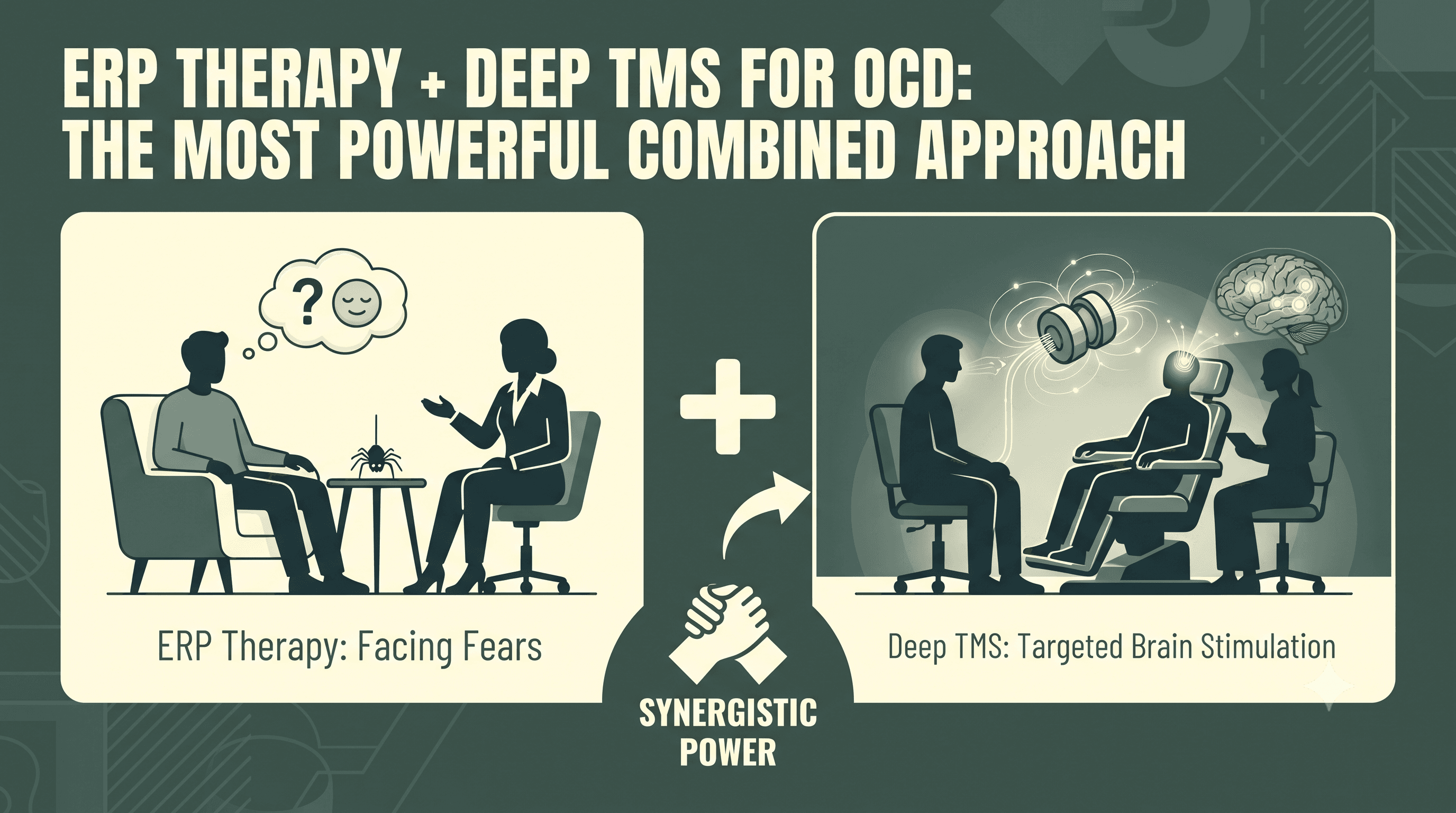
If you've researched OCD treatment, you've likely encountered two terms: ERP therapy and Deep TMS. Both have strong clinical evidence supporting their effectiveness for OCD. But what often isn't discussed clearly is why combining these two approaches produces outcomes that consistently exceed what either achieves on its own — and why this combination represents what leading OCD clinicians now consider the most comprehensive treatment approach available. This blog explains both treatments in detail, what makes their combination so clinically powerful, and how this integrated approach works in practice at clinics like Positive Mind Care in Gurugram.
What Is ERP Therapy and Why Does It Work?
Exposure and Response Prevention therapy is the gold-standard psychological treatment for OCD. It works by systematically targeting the core behavioral mechanism that maintains OCD: the compulsion. In ERP, patients work with a therapist to gradually expose themselves to situations, thoughts, or objects that trigger obsessional distress — and then deliberately refrain from performing the usual compulsive response.
The discomfort during this process is real and intentional. The therapeutic goal is for the patient to remain in the situation or with the thought long enough for the anxiety to naturally reduce without the compulsion. This process — called habituation or, in more contemporary terms, inhibitory learning — teaches the brain through direct experience that the feared outcome doesn't occur, and that the anxiety will decrease on its own without a ritual. Over repeated exposures, the obsessive trigger loses its ability to generate the same level of distress, and the compulsion drive diminishes.
ERP requires both courage and structure. Done well, with a therapist who is genuinely expert in OCD, it produces meaningful improvement in the majority of patients. Done poorly — with excessive accommodation, insufficient exposure challenge, or without proper response prevention — it produces limited results, which is why therapist expertise matters.
What Does Deep TMS Add to ERP?
Deep TMS and ERP address OCD from two entirely different angles. ERP works from the behavioral and cognitive level — changing the learned associations between obsessive triggers and compulsive responses through direct experience. Deep TMS works from the neurological level — directly modulating the overactive brain circuits that generate the disproportionate threat signals underlying OCD in the first place.
For patients with moderate to severe OCD, the intensity of obsessional distress during ERP can be so overwhelming that meaningful engagement with the therapy becomes impossible. These patients may understand intellectually what ERP asks of them, may genuinely want to comply, but find the anxiety generated by exposure attempts so unbearable that they consistently escape through mental compulsions or behavioral avoidance. For these patients, Deep TMS can reduce the baseline neurological "volume" of OCD symptoms enough to make ERP genuinely accessible.
Conversely, for patients who have already made progress with ERP but reached a plateau, Deep TMS can unlock further improvement by addressing the residual neurological hyperactivity that behavioral techniques alone haven't been able to fully resolve.
The Provocation Protocol: Where the Approaches Meet
A uniquely powerful feature of Deep TMS for OCD is the brief provocation step that precedes each session. Before receiving stimulation, the patient is exposed to a personally relevant OCD trigger — a brief written description, image, or thought related to their specific obsessions. This activates the patient's OCD circuits, essentially bringing them "online" just before the stimulation is delivered. The Deep TMS then modulates these circuits while they are active, targeting them with greater precision and relevance.
This provocation protocol creates a point of direct intersection between ERP and Deep TMS — both are engaging the specific OCD circuitry simultaneously, in a way that appears to enhance the therapeutic effect of both.
How the Combined Protocol Is Structured in Practice
At Positive Mind Care, Gurugram, patients undergoing the combined approach typically attend daily Deep TMS sessions on weekdays for six weeks, with the OCD-specific provocation step integrated into each session. Alongside this, ERP therapy sessions are scheduled throughout the same period, allowing the neurological modulation from Deep TMS to be reinforced by concurrent behavioral work.
This parallel structure means that the brain is being addressed at both levels simultaneously — the TMS reducing neurological hyperactivity while ERP is building new behavioral and cognitive patterns. Most patients find that they can engage more productively with ERP exposures during the Deep TMS course than they could before starting it, which reflects the neurological shift beginning to occur.
Patient Experience: What to Expect
Patients going through the combined approach describe the initial phase as requiring commitment — daily clinic visits are needed throughout the acute Deep TMS course, and ERP sessions demand genuine effort. By the midpoint of the course, most patients report that intrusive thoughts feel somewhat less urgent, that the compulsion drive is somewhat reduced, and that they are able to sit with OCD-triggered discomfort more successfully than before.
By the end of the course and the weeks following it, many patients describe being able to engage with exposures that were previously impossible, experiencing meaningful reductions in daily time spent on compulsions, and returning to activities they had previously avoided. These gains then consolidate further with continued ERP practice after the acute Deep TMS course has ended.
Who Benefits Most From the Combined Approach
This combined treatment approach is particularly indicated for patients who have tried ERP but found the anxiety too overwhelming to engage effectively, patients who have partially responded to ERP but plateaued before reaching satisfactory symptom levels, patients with treatment-resistant OCD who haven't responded adequately to medications, and patients who want the most comprehensive treatment available without waiting to see whether each component alone is sufficient.
ERP Beyond the Clinic: Building a Daily Practice
One of the most important things about ERP therapy is that its therapeutic benefit extends far beyond the formal sessions. Patients who make ERP a daily practice — deliberately approaching minor anxiety triggers throughout their day without performing compulsions, even when not in a formal therapy session — build resilience much more rapidly than those who limit their ERP work to scheduled appointments only.
This daily practice doesn't need to be extreme or dramatic. Starting with smaller, more manageable exposures that generate moderate rather than overwhelming anxiety, and gradually working up the anxiety hierarchy, is the standard approach. The consistency of daily practice is more therapeutically important than the intensity of any individual exposure, and when combined with Deep TMS's neurological support, this daily practice becomes more accessible and more productive than it would be without the biological foundation TMS provides.
Frequently Asked Questions
Q1. Do I need to be doing ERP while receiving Deep TMS? Concurrent ERP is strongly recommended for OCD Deep TMS patients and produces the best outcomes. The combined approach is more effective than Deep TMS alone.
Q2. How long does the combined treatment program take? The acute Deep TMS course runs approximately six weeks. ERP therapy typically continues beyond this, for as long as needed to consolidate gains and address remaining symptom areas.
Q3. Is this combination available in Gurugram? Yes. Positive Mind Care, Gurugram, offers both Deep TMS using the OCD-specific BrainsWay H7 protocol and specialist ERP therapy, with treatment plans that integrate both approaches.
Q4. What if I've already done ERP before but didn't find it helpful? The quality of ERP delivery varies significantly. If previous ERP was not delivered by an OCD specialist, or didn't follow proper protocol, a new course by a specifically trained clinician — combined with Deep TMS — may produce very different results.
Conclusion
ERP therapy and Deep TMS are individually effective OCD treatments. Together, they address OCD at both the neurological and behavioral level simultaneously, producing outcomes that consistently outperform what either achieves alone. For patients with moderate to severe OCD, and especially for those who have struggled to engage with ERP due to symptom intensity, this combination represents the most powerful treatment approach currently available — and it is available now at Positive Mind Care in Gurugram.