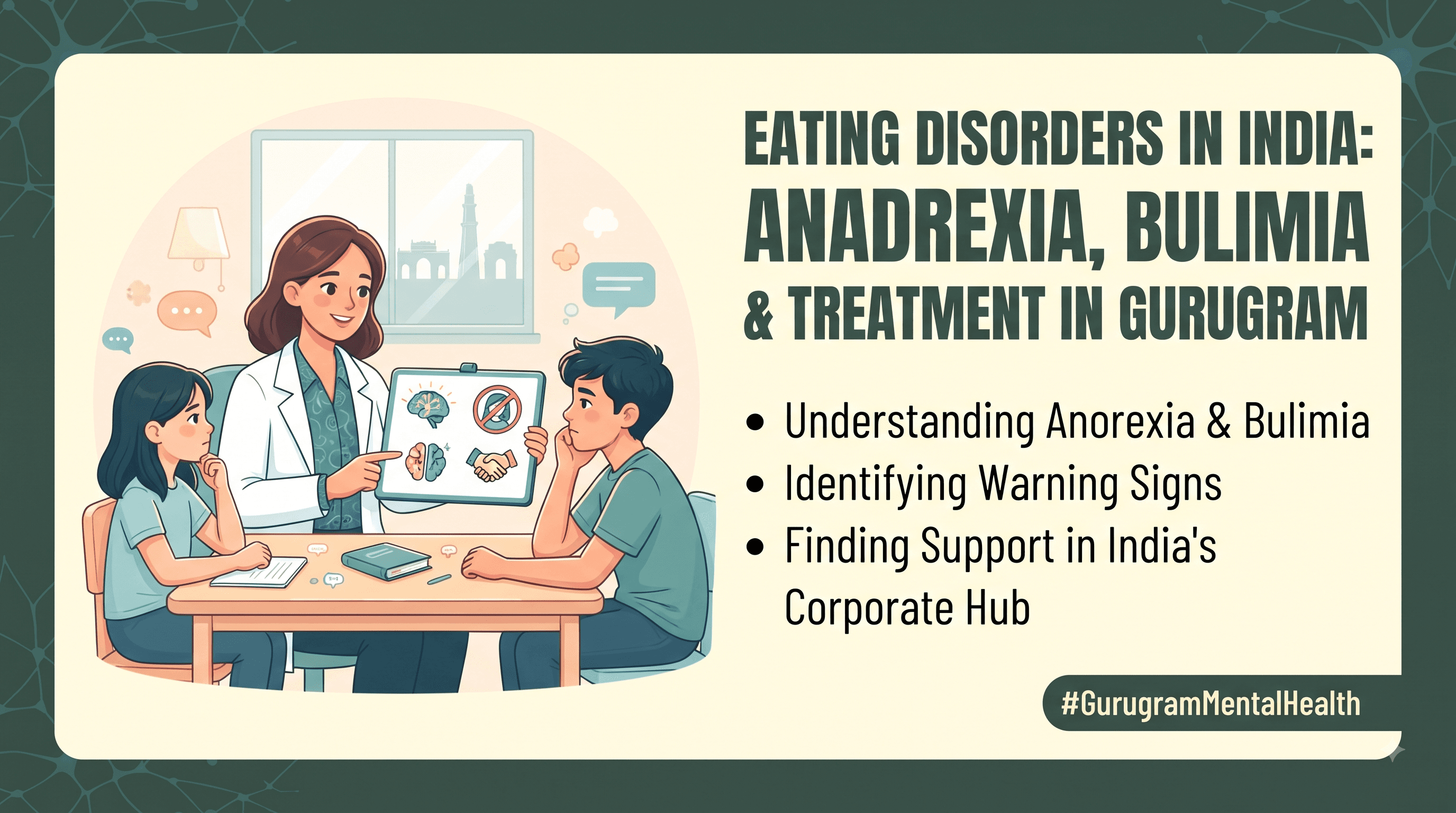
Eating disorders are among the most medically serious and most misunderstood mental health conditions in the world. In India, they carry an additional layer of cultural invisibility — traditionally considered "Western problems," they are increasingly recognized in Indian clinical practice as real, growing, and affecting people across demographic groups, including in Gurugram's professional and student populations where body image pressures, performance culture, and social comparison combine to create significant eating disorder risk.
This blog examines the major eating disorders, explains their neurological and psychological foundations, addresses the specific Indian cultural context, and outlines the evidence-based treatment approaches available in Gurugram for individuals and families dealing with these serious conditions.
Understanding the Major Eating Disorder Diagnoses
Anorexia Nervosa is characterized by significantly low body weight, intense fear of gaining weight, and distorted body image in which the person perceives themselves as overweight despite objective evidence of severe underweight. Anorexia has the highest mortality rate of any mental health condition — combining medical complications of severe malnutrition and the elevated suicide risk associated with its psychiatric severity. It requires a medical and psychiatric approach simultaneously.
Bulimia Nervosa involves recurrent episodes of binge eating — consuming unusually large quantities of food in a discrete time period, accompanied by a sense of loss of control — followed by compensatory behaviors designed to prevent weight gain. These compensatory behaviors most commonly include self-induced vomiting, laxative misuse, excessive exercise, or fasting. Unlike anorexia, bulimia often occurs at normal or above-normal weight, making it invisible to casual observers and allowing it to continue for years without identification.
Binge Eating Disorder (BED) — now formally recognized as a distinct diagnosis — involves recurrent binge episodes without the compensatory behaviors of bulimia. BED is significantly associated with obesity and metabolic complications, and with significant psychological distress including shame, depression, and anxiety. It is the most common eating disorder overall and one of the least recognized in India.
Avoidant/Restrictive Food Intake Disorder (ARFID) involves restriction of food intake based on sensory characteristics, fear of aversive consequences (choking, vomiting), or apparent lack of interest in food — without the weight or body image concerns central to anorexia or bulimia. It is more commonly identified in children and adolescents and is distinct from ordinary food fussiness in its degree of nutritional and functional impairment.
Why Eating Disorders Develop: A Biopsychosocial Model
Eating disorders are not simply choices or vanity — they have neurobiological underpinnings involving serotonin, dopamine, and reward system dysregulation, alongside a perfectionist and harm-avoidant temperament profile that appears consistently in genetic research. They are also powerfully shaped by psychological factors — including anxiety, trauma, need for control, and distorted cognitions about body, weight, and self-worth — and by social and cultural factors including the social environment's messages about body size, appearance, and their relationship to worth and desirability.
In Gurugram's context, social media exposure — Instagram, Snapchat, and fitness-oriented content — provides a relentless stream of idealized body imagery that exacerbates the body dissatisfaction underlying eating disorder risk. Fitness culture, including extreme dieting norms within gym and bodybuilding communities, creates environments where restrictive eating is normalized or even celebrated. Academic and professional pressure, through stress eating and its associated shame cycles, contributes to binge eating patterns.
Eating Disorders in Indian Context
Several features of the Indian cultural context around food and body are clinically relevant. Food is deeply embedded in family, religious, and social practices in Indian culture — family meals are significant, fasting has cultural and religious meaning, and relationships around food are complex. These cultural dimensions require sensitivity in treatment, because eating disorder recovery involves normalization of eating in the context of a culture where food practices are not neutral.
Body image ideals in Indian culture have historically centered on different standards than Western thin-ideal culture — but Western media influence through social media is shifting this rapidly, particularly among Gurugram's internationally educated and exposed young professional population. The result is often a collision between traditional family expectations and contemporary social media appearance standards that creates particular vulnerability.
Families in India often struggle to identify eating disorders — both because awareness is limited and because food restriction can initially appear as commendable self-discipline. By the time family concern reaches clinical attention, significant medical and psychological harm has often already developed.
Treatment for Eating Disorders: A Multidisciplinary Approach
Eating disorder treatment requires a genuinely multidisciplinary approach — psychiatric, psychological, and where medically compromised, medical management together. For anorexia, weight restoration is both a medical priority and a psychological prerequisite — the nutritionally compromised brain is literally unable to engage productively with psychotherapy, and cognitive rigidity associated with starvation makes therapeutic progress very limited until weight is at least partially restored.
Family-Based Treatment (FBT) — also known as the Maudsley Approach — is the most evidence-supported approach for adolescents with anorexia and involves parents taking a central role in nutrition restoration before progressively returning autonomy to the young person. CBT-Enhanced (CBT-E) is the most evidence-supported approach for bulimia and binge eating disorder, directly targeting the cognitive and behavioral mechanisms maintaining the eating disorder cycle.
Medication plays a supporting role — SSRIs have demonstrated efficacy for bulimia and binge eating disorder, and certain medications support weight gain in anorexia. For patients with significant comorbid depression or anxiety driving eating disorder maintenance, Deep TMS is an option at clinics like Positive Mind Care, Gurugram, where the psychiatric team integrates eating disorder care with broader mental health treatment.
When to Seek Help: Warning Signs
For parents of adolescents and young adults, warning signs warranting immediate assessment include significant weight loss, frequent bathroom visits after meals, disappearance of food, excessive exercise that the person is distressed if prevented from completing, persistent talk about "clean eating" or food rules, and increasing social isolation related to avoiding shared meals.
For adults concerned about themselves, persistent preoccupation with food, weight, and body image that occupies significant mental space, eating behaviors that feel out of control or driven by distress rather than hunger, and significant shame or secrecy around eating all indicate that clinical assessment would be valuable.
Frequently Asked Questions
Q1. Are eating disorders only a problem for young women? No. Eating disorders affect people of all genders, ages, and body sizes. They are underrecognized in men, in older adults, and in people with larger bodies.
Q2. Can someone have an eating disorder without being visibly underweight? Yes. Bulimia and binge eating disorder frequently occur at normal or above-normal weight. Weight is not a reliable indicator of whether an eating disorder is present.
Q3. Is hospitalization necessary for eating disorders? Medical hospitalization may be needed when there is significant medical compromise — dangerously low weight, electrolyte disturbance, cardiac risk. Many patients can be treated effectively in an intensive outpatient setting.
Q4. Where can I get eating disorder assessment in Gurugram? Positive Mind Care, Gurugram, provides psychiatric assessment and integrated treatment for eating disorders alongside its broader mental health services, coordinating medical, psychiatric, and psychological care as needed.
Conclusion
Eating disorders are serious, complex conditions with significant medical and psychological consequences — but they are also conditions for which effective treatment exists. In India, reducing the cultural invisibility of eating disorders and increasing access to specialized care is essential for the many people currently suffering without identification or support. If you or someone you care about is showing signs of an eating disorder, professional assessment is the most important first step, and help is available in Gurugram.