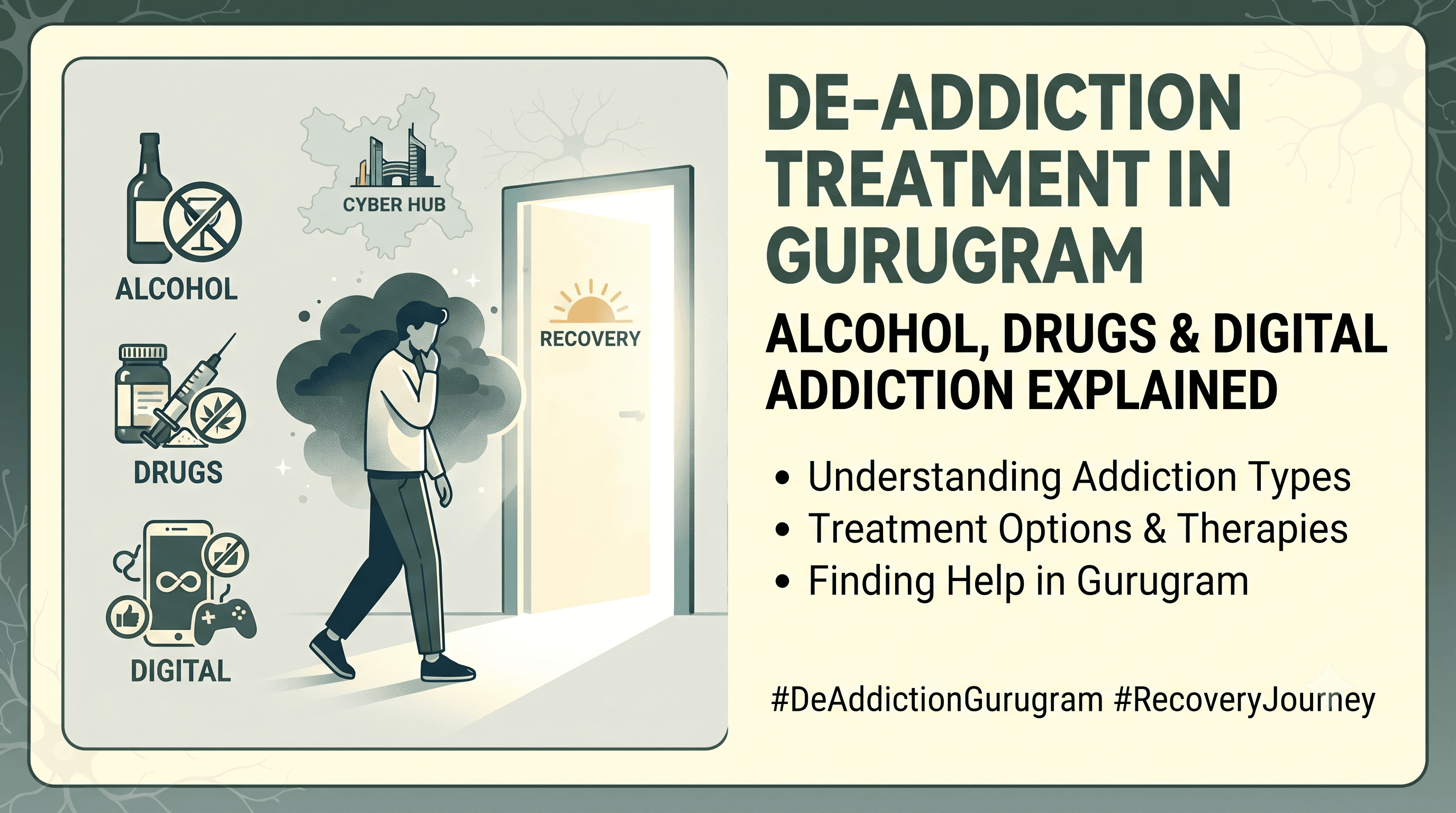
Addiction is one of the most stigmatized conditions in mental health — and simultaneously one of the most misunderstood. In Gurugram's professional culture, where alcohol is woven into networking events, client dinners, and stress-relief rituals, and where stimulant use to maintain performance is more common than most people publicly acknowledge, addiction exists on a spectrum from problematic use to severe substance use disorder. Understanding this spectrum, and knowing when professional help is needed, is essential for individuals, families, and the companies who employ them.
This blog examines addiction comprehensively — its neurological basis, its presentations across alcohol, drugs, and the newer but growing category of digital and behavioral addictions, and the modern treatment options, including Deep TMS therapy, now available in Gurugram for people ready to pursue lasting recovery.
The Brain Science of Addiction: Why Willpower Isn't Enough
The most damaging misconception about addiction is that it is a character weakness — a failure of willpower, self-discipline, or moral strength. This view is not only scientifically incorrect, it actively prevents people from seeking help, because seeking help for something you believe you should be able to control yourself feels like admitting defeat.
Addiction is a brain disorder. Repeated substance use or behavioral engagement hijacks the brain's dopamine reward system — the fundamental mechanism through which the brain motivates goal-directed behavior and records experiences as rewarding. Over time, the reward system is recalibrated around the addictive substance or behavior, reducing its response to natural pleasures while intensifying the pull toward the substance. Simultaneously, the prefrontal cortex — responsible for impulse control, decision-making, and future-oriented thinking — has its function compromised, reducing the brain's ability to override compulsive use even when the person genuinely wants to stop.
This neurobiological recalibration is what makes simple willpower an inadequate tool for overcoming established addiction, and why effective treatment must address the brain directly alongside behavioral and social interventions.
Alcohol Addiction in Gurugram: The Hidden Epidemic
Alcohol is deeply embedded in Gurugram's corporate social culture. Client entertainment, team celebrations, and networking events routinely involve alcohol, creating environments where heavy drinking is normalized and sobriety can feel conspicuous. This social embedding makes it particularly difficult to identify when consumption has crossed from heavy social drinking into alcohol use disorder.
Signs that consumption has become problematic include drinking more than intended on most occasions, unsuccessful attempts to cut down, significant time spent obtaining, using, or recovering from alcohol, craving between drinking occasions, continuing despite negative consequences to work or relationships, needing more to achieve the same effect (tolerance), and experiencing physical withdrawal symptoms when stopping.
Alcohol withdrawal can be medically serious unlike most drugs, alcohol withdrawal can produce life-threatening seizures in those with significant physical dependence, making medical supervision of detoxification essential rather than optional.
Drug Addiction: A Growing Reality in India's Urban Professional Class
While public discourse around drug use in India focuses on specific communities, substance use among urban professionals including cannabis, prescription benzodiazepines, stimulants, and increasingly cocaine and other recreational drugs in higher socioeconomic professional circles is a growing reality that rarely gets discussed openly because professional reputation is too valuable to risk.
Cannabis use has increased substantially in India's young professional population, partly driven by decriminalization conversations and partly by its perception as "harmless" compared to alcohol. Regular, heavy cannabis use is associated with significant anxiety increase, motivational deficit, and risk of cannabis use disorder — with earlier onset use carrying significantly greater risk.
Prescription drug misuse particularly benzodiazepines initially prescribed for anxiety or sleep, and stimulants prescribed for ADHD that are used recreationally or in higher doses than prescribed is another pattern that deserves attention in Gurugram's high-stress professional population.
Digital and Behavioral Addictions: The New Frontier
Alongside substance addictions, behavioral addictions — compulsive engagement with gambling, gaming, pornography, social media, or online shopping — have gained increasing recognition as clinical entities with similar neurological mechanisms to substance addiction, and significant impact on daily functioning and mental health.
In Gurugram's digitally saturated professional environment, social media addiction and compulsive smartphone use are particularly prevalent. The dopaminergic reinforcement built into social media platforms variable reward notifications, social validation signals, and infinite scroll deliberately exploits the same neural pathways as substances. When these patterns begin significantly interfering with sleep, relationships, work performance, and the ability to engage with the offline world, they constitute behavioral addiction warranting clinical attention.
Comprehensive De-Addiction Treatment: What Works
Effective addiction treatment is not a single intervention it is a multimodal program addressing the neurological, psychological, social, and practical dimensions of recovery simultaneously. Medical detoxification, supervised by a psychiatrist or addiction medicine specialist, is the first step for substances that produce physical dependence. Medication-Assisted Treatment (MAT) using evidence-based medications reduces craving and relapse risk significantly for alcohol and opioid use disorders.
Psychotherapy particularly Motivational Interviewing, which builds internal motivation for change, and CBT, which identifies and addresses the thought patterns and triggers driving addictive behavior is a core component. Family therapy addresses the systemic dynamics that often sustain addiction, and group work or peer support provides the community experience that is a powerful recovery ingredient.
For patients with concurrent depression or anxiety which is extremely common in addiction, with the two conditions frequently driving each other Deep TMS therapy offers a non-pharmacological option for addressing the mood component without adding further medication burden. The direct neural circuit modulation of Deep TMS can also target the prefrontal control circuits compromised by addiction, supporting recovery from the neurological level alongside behavioral approaches.
Family Members of People With Addiction: Support and Recovery
Addiction profoundly affects the entire family system, not just the person with the substance use disorder. Family members often develop their own psychological responses to living with addiction including anxiety, depression, enabling behaviors, and trauma that require their own support. At Positive Mind Care, Gurugram, family members of people struggling with addiction can access guidance, psychoeducation, and if needed, their own therapeutic support independent of the patient's treatment journey.
Understanding how to provide support without enabling, how to set appropriate boundaries that protect personal wellbeing while maintaining connection, and how to manage the grief and anger that often accompany a family member's addiction are all areas where professional guidance produces meaningful outcomes. Family involvement in treatment, when the person with addiction is willing, also significantly improves their recovery outcomes making family support services not just a welfare provision but a treatment effectiveness investment.
Frequently Asked Questions
Q1. Is de-addiction treatment confidential? Absolutely. Treatment at private psychiatric clinics like Positive Mind Care is fully confidential and has no reporting obligations to employers or legal authorities for personal substance use.
Q2. Can I get de-addiction treatment without taking leave from work? For mild to moderate presentations, outpatient treatment can be arranged around work schedules. Severe physical dependence may require a brief supervised detoxification that necessitates medical leave.
Q3. How long does addiction treatment take? This varies significantly with substance type, severity, and individual factors. Active treatment phases typically run 3-6 months, with ongoing support and monitoring recommended for 1-2 years thereafter.
Q4. Is Deep TMS used for addiction treatment in Gurugram? Deep TMS for addiction is an emerging area with growing evidence. At Positive Mind Care, it is most commonly used for the concurrent depression or anxiety that accompanies addiction, with meaningful indirect benefit on recovery.
Conclusion
Addiction is a brain condition, not a moral failing. Whether your concern involves alcohol, drugs, prescription medication misuse, or behavioral addiction, effective, evidence-based treatment is available in Gurugram. Recovery is not just possible with the right treatment, it is genuinely achievable. If you or someone you love is struggling, Positive Mind Care's experienced de-addiction team is ready to help without judgment.