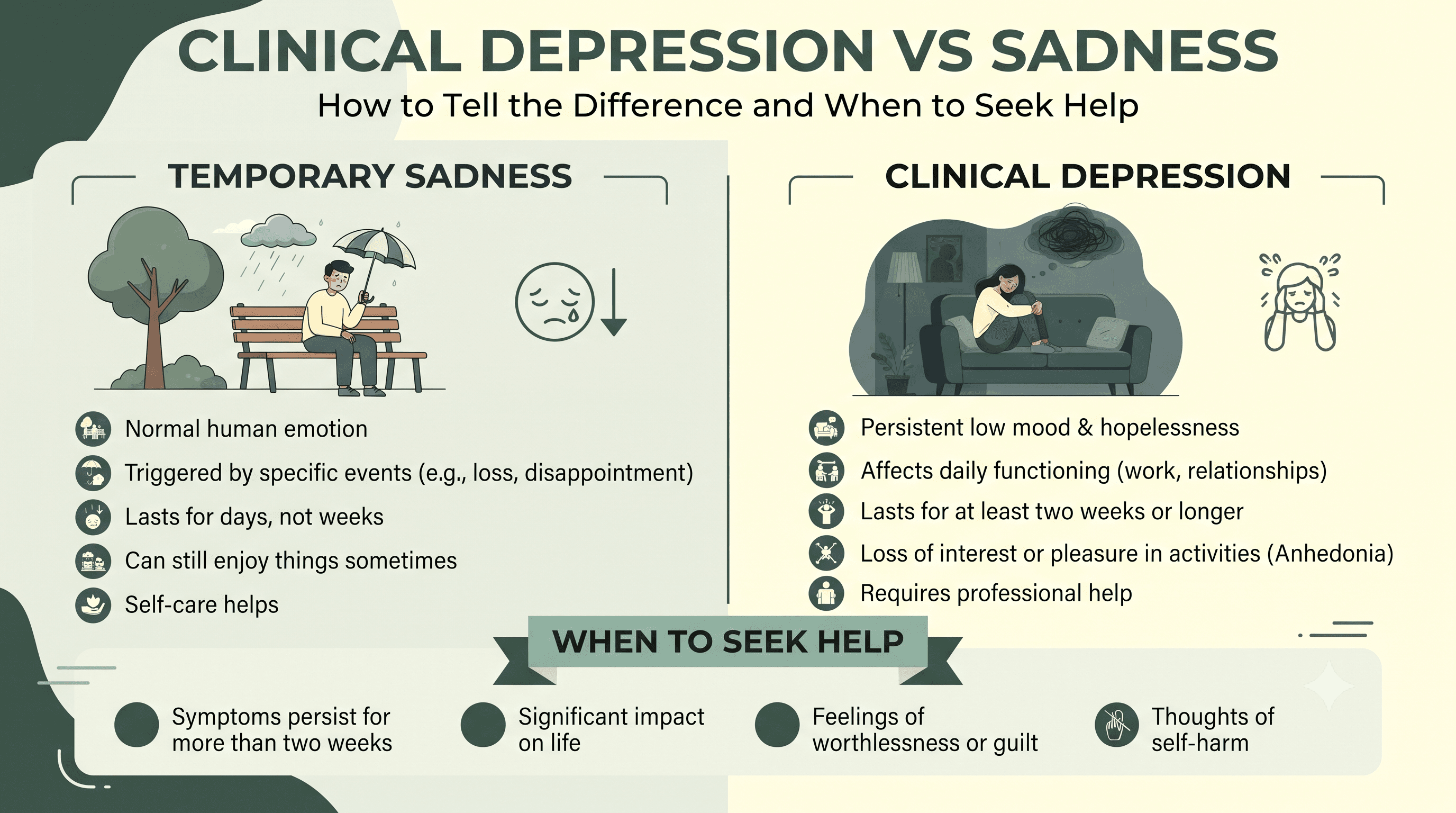
Everyone feels sad sometimes. Sadness is a normal, healthy human emotion — a natural response to loss, disappointment, failure, or life's inevitable difficulties. But clinical depression is something fundamentally different, and the confusion between the two is one of the most significant barriers to people seeking timely, appropriate help. When people dismiss genuine clinical depression as "just sadness" or attribute it to a character weakness, they delay treatment that could meaningfully restore their quality of life — sometimes for years.
Understanding the difference between normal sadness and clinical depression isn't about clinical precision for its own sake. It's about recognizing when something has shifted from an ordinary human experience into a medical condition that deserves professional attention.
The Key Features of Normal Sadness
Sadness, in its healthy form, is responsive. It connects to a specific cause — a loss, a disappointment, a painful experience — and it evolves over time. Normal sadness allows the person to still experience moments of relief, connection, or pleasure. It doesn't uniformly color every waking moment. It doesn't eliminate the capacity for positive emotion entirely. Even in profound grief, people often experience periods of warmth, shared laughter, or peaceful moments alongside intense sorrow.
Normal sadness is also proportional. The intensity and duration of the emotional response broadly matches the significance of the precipitating event. Sadness after a major bereavement is expected to be profound and prolonged. Sadness after a minor disappointment is expected to be brief. When the emotional response consistently exceeds what the situation would warrant, and when it persists beyond what seems reasonable, this signals something beyond ordinary sadness.
Clinical Depression: The Distinguishing Features
Clinical depression differs from sadness in several important dimensions. Pervasiveness is perhaps the most defining feature — in clinical depression, low mood or emotional emptiness pervades virtually every hour of every day, across weeks, without meaningful periods of relief. The person cannot cheer up in response to positive events in the way they normally could.
Anhedonia — the loss of ability to feel pleasure or interest in activities that were previously enjoyed — is a particularly characteristic marker of clinical depression. This isn't simply reduced enthusiasm; it's a genuine inability to access positive emotional states that previously came naturally. Hobbies, relationships, food, and experiences that once brought joy feel flat or meaningless.
Physical and cognitive changes accompany clinical depression in ways that normal sadness doesn't produce. Sleep disturbance — whether insomnia or hypersomnia — is almost universal. Appetite changes and corresponding weight changes are common. Cognitive slowing — difficulty concentrating, making decisions, or thinking clearly — affects daily functioning significantly. Energy depletion is profound, making even basic tasks feel effortful. These physical and cognitive symptoms distinguish clinical depression from sadness at the functional level and reflect the genuine neurobiological changes occurring in the depressed brain.
The Critical Importance of Grief
Grief after significant loss — bereavement, relationship breakdown, major disappointment — shares some surface features with clinical depression and deserves thoughtful consideration. Intense grief is normal, expected, and not inherently a medical condition. However, grief can evolve into clinical depression when the normal mourning process becomes disrupted — when improvement doesn't occur over time, when the person loses the capacity to function at all, or when features like severe worthlessness, complete anhedonia, or suicidal ideation emerge.
Psychiatrists recognize this distinction and don't pathologize normal grief. But they do watch for the transition from grief to clinical depression, which benefits from treatment even when it begins in the context of genuine loss.
Depression's Impact on Identity and Self-Perception
One of the most insidious features of clinical depression is how thoroughly it distorts self-perception. People in the midst of a depressive episode often view their current state as an accurate reflection of reality — they believe they genuinely are worthless, that things genuinely are hopeless, that they genuinely have always been like this and always will be. This cognitive distortion is itself a symptom of depression, not an accurate assessment of their actual situation.
This is one reason why depression often prevents people from seeking treatment: the disorder itself generates a convincing internal narrative that nothing will help. Overcoming this cognitive distortion — often with the support of a trusted person who can reflect reality back — is frequently what allows people to take the step of seeking professional assessment.
When to Seek Help: Practical Guidance
Seeking professional evaluation is warranted when low mood, loss of interest, or emotional emptiness has persisted for two weeks or more, when these symptoms are affecting the ability to function at work or in relationships, when physical symptoms like sleep disturbance or appetite change have accompanied mood changes, or when thoughts about death, dying, or self-harm have arisen.
In Gurugram, Positive Mind Care provides thorough, compassionate initial assessments for people concerned about depression, including comprehensive evaluation of symptom severity, timeline, and impact on daily functioning. This assessment determines the most appropriate level and type of treatment — which may range from therapy and lifestyle support for milder presentations to medication, and advanced Deep TMS for more severe or treatment-resistant cases.
The Role of Stigma in Delayed Diagnosis
In Gurugram's competitive professional environment, admitting to depression carries significant social risk for many people. Depression is often perceived as incompatible with professional competence, personal strength, or social desirability. This stigma drives people to minimize their symptoms, attribute them to external factors like tiredness or overwork, and delay seeking help until the condition has become significantly more severe.
Reducing this delay requires both individual recognition of what clinical depression is and cultural shifts in how it is understood and discussed. Sharing accurate information about depression — that it is a medical condition, not a weakness; that it is common even among high-performing professionals; and that it is very treatable — is part of what creates a context where people feel able to seek help sooner.
Frequently Asked Questions
Q1. Can a person be depressed without feeling sad? Yes. Some people with clinical depression present with emotional numbness, irritability, or physical symptoms rather than overt sadness. This masked presentation is common in men and in people under professional pressure to appear functional.
Q2. Is it possible to be high-functioning and clinically depressed? Yes. Many people maintain external functioning — attending work, meeting social obligations — while experiencing significant internal depression. This "high-functioning depression" often goes unrecognized by others.
Q3. Can depression develop without a triggering event? Yes. While life stressors can trigger episodes, clinical depression can also arise without a clear external cause, reflecting the underlying neurobiological vulnerability rather than situational factors.
Q4. If I've been depressed before and recovered, does that mean I have MDD? Not necessarily. A single episode with full recovery can occur. However, multiple episodes suggest recurrent MDD, which warrants more proactive ongoing management.
Conclusion
Sadness is a human experience. Depression is a medical condition. Understanding this distinction — and recognizing which one you or someone close to you is experiencing — is the foundation of getting appropriate help. In Gurugram, professional support for depression is available with genuine expertise and compassion. If something feels persistently, pervasively wrong — beyond ordinary sadness, beyond normal tiredness — taking that feeling seriously and seeking assessment is the right response.