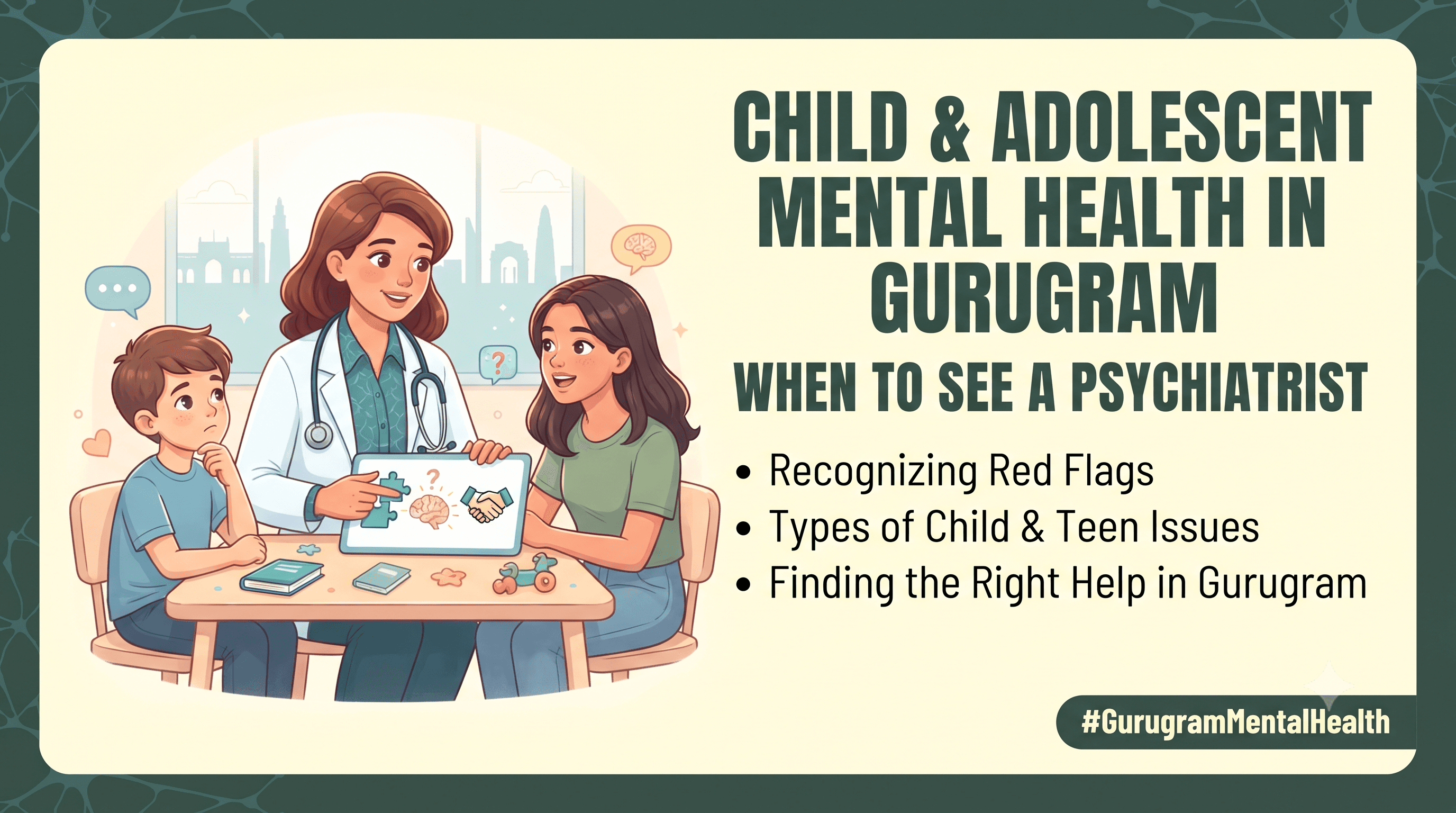
Gurugram's children and teenagers face a mental health landscape that is genuinely more demanding than anything previous generations encountered. Academic pressure in competitive schools, exposure to social comparison and cyberbullying through smartphones, awareness of global uncertainties from a very young age, and the emotional aftermath of pandemic-era disruption to schooling and social development combine to create a perfect storm of mental health risk factors for young people growing up in this city.
Yet child and adolescent mental health remains one of the most underserved areas in Indian healthcare, partly due to limited awareness among parents about what constitutes a normal developmental challenge versus a clinical condition, and partly due to significant stigma around seeking psychiatric care for a child.
Why Children and Adolescents Aren't Just Small Adults
Mental health conditions in children and teenagers present differently from adult presentations, which is one reason they're frequently missed. Depression in children often presents more through irritability, aggression, somatic complaints (stomachaches, headaches), and school refusal than through the sadness and withdrawal more typical in adults. Anxiety in young children may manifest as clinginess, tantrums, and physical symptoms rather than articulated worry. ADHD in girls is more frequently the inattentive subtype than the hyperactive presentation that is more commonly recognized, leading to systematic underdiagnosis.
Adolescents carry additional complexity because developmental features of adolescence — risk-taking, emotional intensity, peer orientation, identity exploration overlap significantly with features of emerging mental health conditions, making differentiation require genuine clinical expertise. What's developmentally normal in a 14-year-old and what requires clinical attention is a nuanced judgment that benefits from assessment by a clinician specifically trained in adolescent mental health.
Common Childhood Mental Health Conditions in Gurugram
ADHD is the most commonly presenting childhood mental health condition in clinical settings, and in Gurugram's academically competitive schools, its impact on learning and behavior is particularly visible. Early, accurate ADHD diagnosis and appropriate treatment medication, educational support, and behavioral guidance can transform academic trajectories that are heading toward increasing failure and frustration.
Anxiety disorders in children including separation anxiety, generalized anxiety, social anxiety, and specific phobias are extremely common and respond well to child-adapted CBT and, when needed, age-appropriate medication. In Gurugram's high-pressure academic environment, perfectionism-driven anxiety is increasingly common even in primary school-aged children.
Depression in adolescents is a clinical priority due to its association with suicidal ideation and self-harm, which require urgent assessment and intervention. The presence of suicidal thoughts in a teenager is always a clinical emergency that warrants immediate professional attention, not reassurance or waiting.
OCD presenting in childhood is often more severe in impact than adult-onset OCD due to the developing brain's greater plasticity in both directions — it can entrench patterns more deeply, but it also responds more dramatically to early, evidence-based treatment.
The Impact of Academic Pressure in Gurugram's Schools
Gurugram hosts some of India's most competitive schools both Indian curriculum and international school systems and the academic pressure these environments generate is palpable. Children as young as 7 or 8 are in coaching classes, and by secondary school, examination anxiety, burnout, and competitive stress are commonplace. The mental health consequences of this pressure are real and include anxiety disorders, depression, school refusal, and in severe cases, suicidal crisis.
Parents in Gurugram's professional community often struggle with the tension between wanting their child to succeed academically and recognizing when the pressure is causing harm. A clinical assessment can help families understand where their child is on the spectrum from normal academic stress to clinically significant impairment and what targeted support would help.
Warning Signs Parents Should Not Ignore
Several behavioral and emotional changes in children and teenagers warrant professional evaluation. Persistent school refusal or significant academic decline without obvious explanation suggests emotional or learning difficulties that need assessment. Sleep disturbance lasting more than a few weeks difficulty falling asleep, nightmares, or sleep refusal often signals anxiety. Significant social withdrawal refusing to spend time with friends, dropping activities can indicate depression or social anxiety. Self-harm behaviors, including cutting, burning, or other self-injury, require urgent professional attention.
Eating behavior changes particularly food restriction or purging behaviors in adolescent girls warrant psychiatric evaluation. Statements indicating hopelessness or a desire to die even expressed as "I wish I weren't here" must always be taken seriously and evaluated clinically rather than dismissed as attention-seeking.
How Child and Adolescent Psychiatric Assessment Works
Child and adolescent psychiatric assessment is adapted to the developmental level of the young person and involves the child or teenager directly, not just parents providing information about them. The assessment explores the young person's own understanding of their experience, builds rapport at their pace, and uses developmentally appropriate communication. Family assessment is an integral part parents provide essential historical context and their own observations, and family dynamics are evaluated as a component of the formulation.
At Positive Mind Care, Gurugram, child and adolescent assessments are conducted by experienced clinicians who understand the specific developmental, social, and cultural context of Gurugram's young people including academic pressure, competitive school environments, and the digital social world they navigate.
The Role of Schools in Supporting Mental Health in Gurugram
Gurugram's schools particularly its international and premium Indian curriculum institutions are increasingly recognizing the role they need to play in student mental health. School counselors, mental health literacy programs, and anti-stigma initiatives are growing features of more progressive school environments. Parents choosing schools for children with known mental health needs should inquire specifically about the school's mental health support infrastructure, the availability of a qualified counselor, the school's approach to academic accommodation for mental health difficulties, and its anti-bullying policies and enforcement.
For children receiving active psychiatric treatment including medication or structured therapy coordination between the clinic and school can significantly improve outcomes. Information sharing with the school (with appropriate consent and boundaries) ensures that the child receives consistent support across home and educational environments. Positive Mind Care, Gurugram, routinely collaborates with school counselors and educational psychologists when this coordination serves the child's clinical needs.
Frequently Asked Questions
Q1. At what age can a child see a psychiatrist? Psychiatric assessment is appropriate at any age. Younger children may be assessed through parent interview and observation. There is no minimum age for seeking assessment if there are concerns.
Q2. Will psychiatric assessment label my child? A clinical assessment provides understanding, not a label. It helps parents and educators understand what a child needs, which leads to better support rather than worse outcomes.
Q3. Can a teenager take antidepressants? Antidepressant medication for adolescents is considered carefully and prescribed when the clinical benefit outweighs risk, with close monitoring. The decision is made with the young person and their parents.
Q4. What should I do if my teenager mentions suicidal thoughts? Take it seriously every time. Contact a mental health professional urgently. Do not leave them alone until assessed. Positive Mind Care can provide urgent assessment for young people in crisis.
Conclusion
Children and teenagers in Gurugram deserve the same quality of mental health support that we would want for any adult in distress. Seeking assessment for a young person showing warning signs is not overreacting — it is the most responsible parenting decision a family can make. Early identification and appropriate treatment during childhood and adolescence consistently produces better lifetime outcomes than waiting until problems have become entrenched.