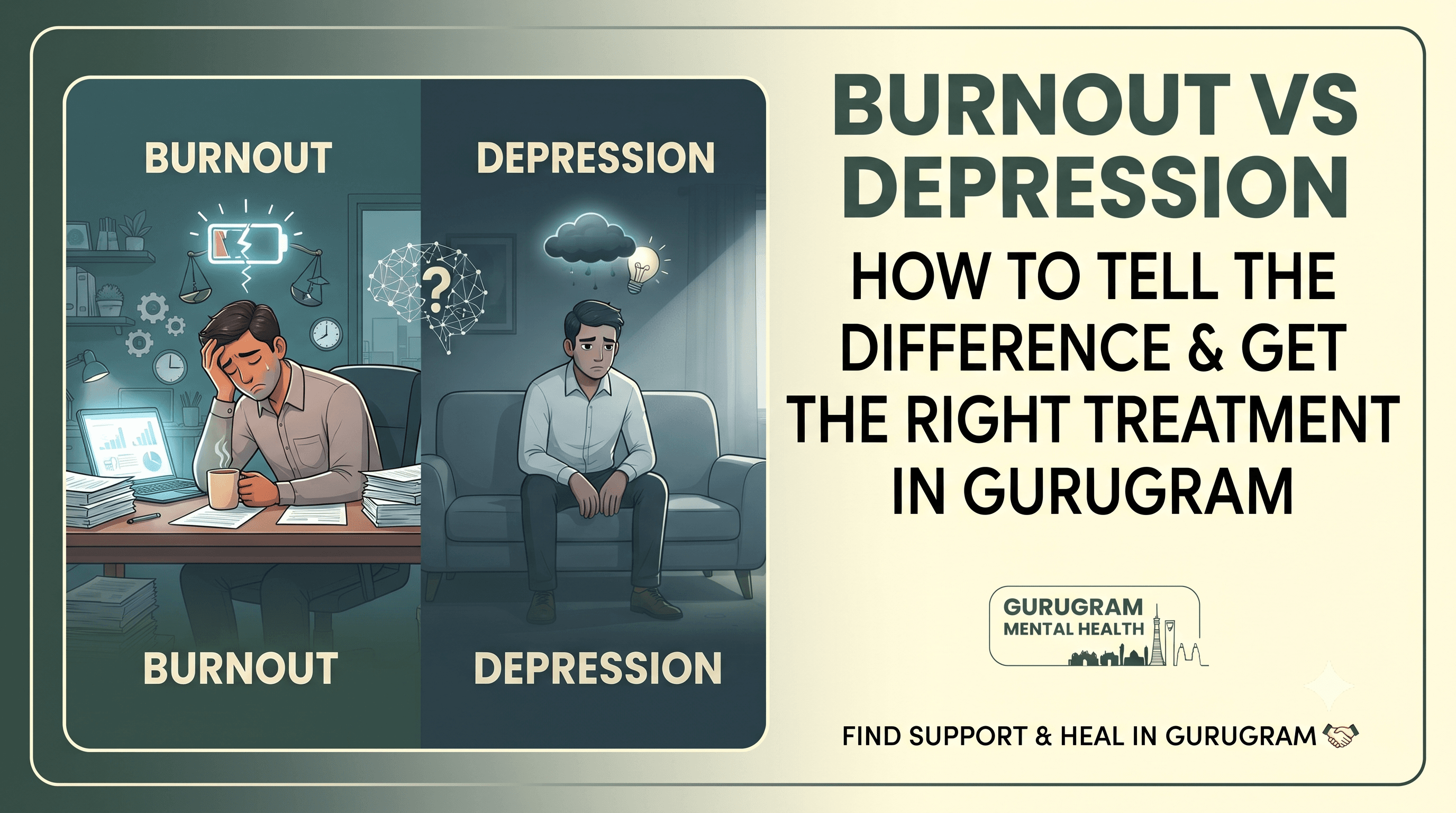
"Burnout" has become one of the most commonly used words in Gurugram's professional vocabulary a word that covers everything from needing a vacation after a tough quarter to a serious mental health condition requiring clinical intervention. This semantic elasticity is a problem, because genuine burnout and clinical depression, though they share significant overlap, are different conditions requiring different approaches, and misidentifying one as the other leads to treatments that don't work.
Understanding where burnout ends and depression begins and recognizing when the line between them has been crossed is one of the most important mental health literacy skills for Gurugram's working population.
Defining Burnout: WHO's Clinical Framework
The World Health Organization officially recognized burnout in 2019 as an occupational phenomenon not a medical condition in itself, but a syndrome resulting specifically from chronic workplace stress that has not been successfully managed. WHO defines it through three dimensions: feelings of energy depletion or exhaustion, increased mental distance from one's job or feelings of negativism or cynicism related to one's job, and reduced professional efficacy.
The critical distinguishing feature in this definition is context specificity — burnout is specifically and exclusively work-related. The person experiencing burnout may function reasonably well, or even feel relief, in non-work contexts. They may enjoy their weekend. They may feel their sense of humor return when away from office demands. Their difficulties are real and significant, but they are anchored to the occupational context.
What Makes Clinical Depression Different
Clinical depression Major Depressive Disorder permeates the entire experience of a person's life, not just their relationship with work. Where burnout lifts somewhat when the person leaves the work context, depression follows them home, into their leisure activities, into their relationships, and into their sleep. Anhedonia the inability to experience pleasure from previously enjoyable activities doesn't differentiate between work and non-work activities.
Depression also carries cognitive features negative self-perception, hopelessness, worthlessness, concentration difficulties that go beyond occupational dissatisfaction into a broader, darker worldview. And depression frequently includes neurovegetative symptoms sleep disruption, appetite changes, psychomotor slowing that reflect its neurobiological nature rather than a psychological response to a specific stressor.
Most importantly, depression carries a risk that burnout does not: suicidal ideation. Thoughts of death, hopelessness about the future, or desires to escape one's existence however passively expressed distinguish clinical depression from burnout with clinical importance.
The Overlap: Where Burnout and Depression Meet
The boundary between burnout and depression is not always clean. Prolonged, severe burnout can trigger a depressive episode in biologically vulnerable individuals the chronic stress of burnout disrupts sleep, neuroendocrine function, and social connection in ways that create the neurobiological conditions for depression to develop. In this sense, burnout can be a pathway to depression rather than simply a separate condition.
There is also significant symptom overlap: exhaustion, emotional detachment, reduced engagement, irritability, and cognitive performance decline feature in both. This overlap means that self-assessment is unreliable for distinguishing the two, and that professional evaluation is the only reliable way to determine what's driving the symptoms and therefore what treatment will actually help.
Why the Distinction Matters for Treatment
The distinction matters because the appropriate interventions differ meaningfully. Burnout primarily responds to occupational changes workload reduction, boundary-setting, role restructuring alongside rest, social support, and addressing the workplace factors driving it. Lifestyle interventions, coaching, and brief therapy can produce significant improvement. Antidepressants or advanced neurological interventions like Deep TMS are not the right first response to burnout without depression.
Depression, particularly moderate to severe depression, requires clinical treatment medication, psychotherapy, and potentially advanced options like Deep TMS because its neurobiological component doesn't resolve simply through rest, vacation, or improved working conditions. Many genuinely depressed patients in Gurugram continue extending their medical leave, taking vacations, or changing jobs without improvement, because the depression they have isn't responding to what is actually being targeted.
The Assessment Process
A qualified psychiatrist can assess the distinction between burnout and depression through a structured clinical interview that evaluates symptom scope (work-limited or pervasive), neurovegetative features, cognitive symptoms, duration, severity, and functional impact beyond the occupational context. Standardized tools like the PHQ-9 for depression severity and the MBI (Maslach Burnout Inventory) provide quantified benchmarks.
At Positive Mind Care, Gurugram, the assessment process is specifically designed for working professionals, with clinicians who understand the specific culture and pressures of Gurugram's corporate environment and can contextualize the clinical picture accurately within it.
When Both Are Present
It is entirely possible and clinically common for both burnout and depression to be present simultaneously. In this case, treatment must address both the workplace contributors and the clinical depression. Managing only the workplace factors while a clinical depression goes untreated produces partial improvement at best. Treating only the depression while returning the person to the same unsustainable workplace conditions risks relapse.
Recovering From Burnout: What the Process Actually Looks Like
Recovery from significant burnout particularly when it has progressed into clinical depression is rarely a simple matter of taking a holiday and returning refreshed. Genuine burnout recovery is a process that requires structural changes alongside recovery time. Simply removing the person from the stressful environment and then returning them to it unchanged reliably produces relapse within weeks, because the burnout was a product of that environment and their relationship to it, and neither has changed.
Effective burnout recovery typically involves a combination of adequate rest during the acute phase, therapeutic work addressing the cognitive patterns perfectionism, difficulty setting limits, identity fusion with work that made burnout possible, practical changes to workload or role structure, and the gradual rebuilding of non-work sources of meaning and recovery. For burnout that has crossed into depression, clinical treatment runs alongside these structural changes. A return-to-work plan developed collaboratively with the clinical team and employer, gradual in pace and structured in its expectations, consistently produces better sustained outcomes than abrupt returns to full workload.
Frequently Asked Questions
Q1. Can a vacation cure burnout? For mild burnout, adequate rest can produce meaningful recovery. Severe burnout or burnout that has transitioned to depression requires more structured intervention.
Q2. Should I take medical leave if I'm burned out? This depends on severity. Brief recovery time can be valuable, but simply removing the person from work without addressing either occupational structure or potential depression rarely produces lasting improvement.
Q3. How do I know if my burnout has become depression? Key signs include: low mood that persists through weekends and vacations, loss of pleasure from non-work activities, sleep and appetite changes, feelings of worthlessness, and thoughts of death or self-harm. If these are present, clinical assessment is urgent.
Q4. Can Deep TMS help with burnout-related depression? Yes. Where burnout has transitioned to clinical depression, or where both coexist, Deep TMS is a highly effective treatment for the depressive component alongside addressing workplace factors.
Conclusion
Burnout and depression are not the same thing — but they are not mutually exclusive either. In Gurugram's demanding professional environment, recognizing which one you're dealing with is the essential first step toward getting treatment that actually works. Positive Mind Care offers specialist assessment and tailored treatment for both, with the experience and clinical expertise to make that distinction accurately and guide you toward recovery.