Introduction
Life does not always go according to plan. Unexpected challenges, professional pressures, relationship difficulties, financial uncertainty, health concerns and rapid social changes can make the future feel unpredictable. In such situations, it is natural to experience stress, fear, anxiety or emotional exhaustion.
But what helps some individuals navigate difficult circumstances while others find themselves overwhelmed?One important psychological factor is psychological resilience.Psychological resilience is the ability to adapt, recover and maintain emotional well-being when faced with stress, adversity or significant life changes. It does not mean avoiding difficulties or pretending everything is fine. Instead, it involves developing the emotional strength, mental flexibility and coping skills needed to face challenges constructively.
In an increasingly uncertain world, building psychological resilience has become an essential part of maintaining good mental health.
What Is Psychological Resilience?
Psychological resilience refers to the capacity to adapt positively when confronted with challenging experiences. It allows individuals to manage difficult emotions, learn from setbacks and gradually regain a sense of stability.
Resilience is often misunderstood as being mentally strong all the time. However, resilient individuals also experience sadness, disappointment, fear and frustration. The difference lies in how they respond to these emotions and move forward.For example, a student who does not perform well in an examination may initially feel disappointed. However, instead of allowing the setback to define their abilities, they reflect on their preparation, identify areas for improvement and develop a better strategy.
Similarly, an individual experiencing professional uncertainty may feel anxious about the future but can learn to focus on manageable actions rather than becoming overwhelmed by circumstances beyond their control.
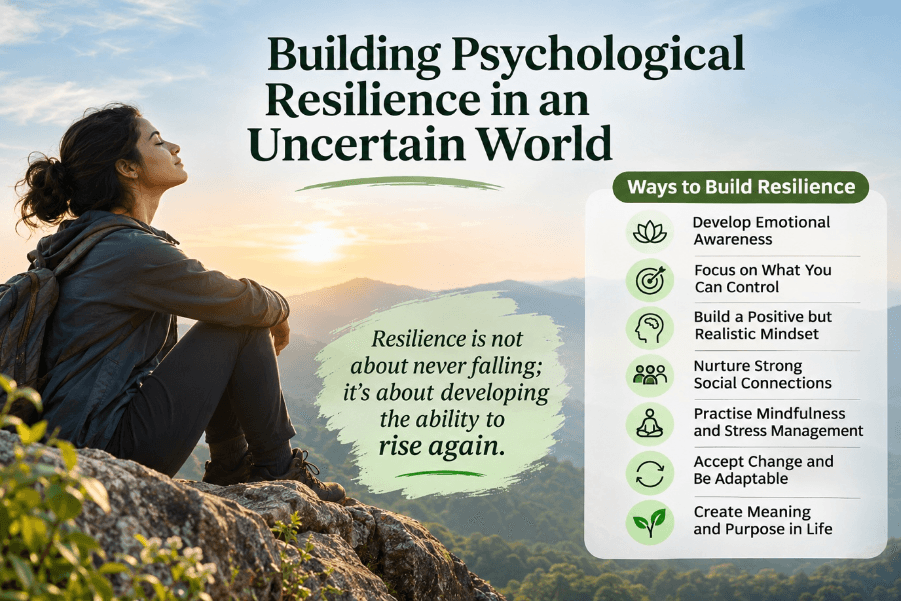
Resilience is not about never falling; it is about developing the ability to rise again.
Why Is Psychological Resilience Important in Today's World?
Modern life presents unique psychological challenges. Constant connectivity, social comparison, competitive environments and uncertainty about the future can significantly influence emotional well-being.
Some common situations that test psychological resilience include:
1. Professional and Academic Pressure
Competition, demanding deadlines, career transitions and fear of failure can create continuous psychological stress.
2. Relationship Challenges
Conflicts, misunderstandings, separation and changing family dynamics can affect emotional stability.
3. Financial Uncertainty
Economic difficulties, job insecurity and financial responsibilities can create feelings of helplessness and worry.
4. Social Media and Comparison
Constant exposure to carefully presented versions of other people's lives can contribute to self-doubt, dissatisfaction and unrealistic expectations.
5. Unexpected Life Changes
Illness, loss, relocation and other unexpected circumstances can challenge an individual's sense of security and control.
Developing resilience helps individuals respond to these situations with greater emotional awareness, adaptability and confidence.
7 Ways to Build Psychological Resilience
Psychological resilience is not simply an inborn personality characteristic. It can be strengthened through everyday habits, supportive relationships and intentional psychological practices.
1. Develop Emotional Awareness
The first step towards resilience is understanding your emotions.
Many individuals attempt to suppress uncomfortable feelings because they believe that expressing sadness, anger or fear is a sign of weakness. However, ignoring emotions does not necessarily make them disappear.
Instead, practise identifying what you are feeling and why.
Ask yourself:
· What emotion am I experiencing right now?
· What situation triggered this feeling?
· Is my reaction based on facts or assumptions?
· What do I need at this moment?
Emotional awareness helps individuals respond thoughtfully rather than react impulsively.
2. Focus on What You Can Control
Uncertainty often becomes overwhelming when we spend too much time worrying about things beyond our control.
You cannot always control other people's behaviour, unexpected events or future outcomes. However, you can influence your decisions, responses, habits and actions.
For example, instead of worrying constantly about whether you will get a particular job, focus on improving your skills, preparing for interviews and exploring opportunities.
Shifting attention towards controllable factors creates a greater sense of personal agency and reduces unnecessary psychological stress.
3. Develop a Positive but Realistic Mindset
Resilience does not require unrealistic optimism. It involves learning to view challenging situations with perspective and recognising that difficulties do not necessarily determine future outcomes.
Cognitive reframing is a useful psychological technique that involves identifying unhelpful thought patterns and replacing them with more balanced interpretations.
For example:
· Instead of thinking, "I always fail," consider, "This experience did not go as expected, but I can learn from it."
· Instead of thinking, "I cannot handle this," consider, "This is difficult, but I can approach it one step at a time."
· Instead of thinking, "Everything is going wrong," consider, "Some aspects of my life are challenging, but not everything is beyond my control."
Changing the way we interpret experiences can influence our emotional responses and behaviour.
4. Build Strong Social Connections
Human beings are naturally social. Emotional support from friends, family members, colleagues and trusted individuals plays an important role in psychological well-being.
Talking about your concerns can help you gain perspective, feel understood and reduce emotional isolation.
Building resilience does not mean handling everything alone. In fact, knowing when to seek support is an important sign of emotional strength.
Make time for meaningful conversations and maintain relationships that provide mutual understanding, encouragement and emotional security.
5. Practise Mindfulness and Stress Management
Mindfulness involves paying attention to the present moment without immediately judging your thoughts or feelings.
When individuals constantly worry about the future or revisit past experiences, they may find it difficult to remain emotionally balanced.
Simple mindfulness practices can help:
· Practise deep breathing for a few minutes.
· Spend time in nature.
· Try meditation or guided relaxation.
· Engage in mindful walking.
· Take short breaks from digital devices.
· Maintain a regular sleep schedule.
These practices can support stress management and improve awareness of emotional experiences.
6. Accept Change and Develop Adaptability
One of the most important aspects of resilience is accepting that change is a natural part of life.
People often experience distress when reality does not match their expectations. However, constantly resisting situations that cannot be changed can increase frustration and emotional exhaustion.
Adaptability involves being willing to reconsider plans, explore alternative solutions and learn new skills.
Rather than viewing change only as a threat, try to identify the opportunities for growth and learning that may emerge from it.
7. Create Meaning and Purpose in Life
Having a sense of purpose can help individuals navigate difficult experiences.
Purpose does not necessarily come from achieving major professional or personal milestones. It can also emerge through meaningful relationships, personal development, helping others, creative activities and contributing to society.
When individuals understand what matters to them, they may find it easier to make decisions and maintain motivation during challenging circumstances.
Take time to identify your values and establish realistic goals that give direction to your everyday life.
The Role of Psychology in Building Resilience
Psychology plays a significant role in understanding how individuals respond to stress, adversity and uncertainty.Different psychological approaches can help individuals recognise unhelpful thinking patterns, develop healthier coping mechanisms and improve emotional regulation.Some useful approaches include:
Cognitive Behavioural Therapy (CBT): Helps individuals identify and modify unhelpful thoughts and behaviours that contribute to emotional distress.
Positive Psychology: Focuses on strengths, optimism, gratitude, meaning and factors that contribute to human flourishing.
Mindfulness-Based Approaches: Encourage present-moment awareness and healthier responses to difficult thoughts and emotions.
Counselling and Psychotherapy: Provide a supportive environment where individuals can explore personal challenges, understand emotional patterns and develop effective coping strategies.
Professional psychological support can be particularly valuable when stress, anxiety or emotional difficulties begin interfering with everyday functioning.
When Should You Seek Professional Help?
Resilience does not mean managing every challenge independently. Sometimes, despite making consistent efforts, individuals may experience emotional difficulties that require professional attention.
Consider seeking support from a qualified mental health professional if you experience:
· Persistent anxiety or excessive worrying.
· Continuous sadness or loss of interest in activities.
· Difficulty managing everyday responsibilities.
· Sleep disturbances or significant changes in appetite.
· Emotional exhaustion or frequent irritability.
· Feelings of hopelessness or helplessness.
· Difficulty coping with major life transitions or traumatic experiences.
Seeking psychological support is not a sign of weakness. It is a constructive step towards understanding yourself and improving your mental well-being.
Conclusion: Resilience Is a Skill You Can Build
An uncertain world does not necessarily mean an unhappy life. Although we cannot predict every challenge or control every outcome, we can gradually develop the psychological resources needed to navigate difficult experiences.
Building psychological resilience begins with small but meaningful steps: understanding your emotions, developing healthier thought patterns, maintaining supportive relationships, practising mindfulness and accepting that change is part of life.
Remember that resilience is not about being strong every single day. Some days require courage, while others require patience, rest or asking for help.
You may not always have control over what happens to you, but with the right support and coping strategies, you can develop healthier ways to respond to life's challenges.