Introduction
Consider not having to wait for a standard professional appointment in order to receive mental health help at any time, get an initial psychological exam in a matter of minutes, and spot early indicators of emotional distress. These kinds of opportunities are becoming a more significant component of contemporary healthcare as artificial intelligence (AI) develops.
A significant worldwide public health issue is mental health. People of all ages and socioeconomic backgrounds struggle with anxiety, sadness, stress, loneliness, and other psychological issues. Despite increased awareness, many people still have limited access to professional mental healthcare due to financial limitations, social stigma, a lack of qualified experts, and geographic obstacles.Artificial Intelligence is creating new opportunities to address some of these challenges. From AI-powered mental health screening and digital counselling platforms to predictive analytics and personalised treatment planning, technology is transforming how psychological support can be delivered.However, an important question remains: Can Artificial Intelligence truly improve mental healthcare, and what challenges must we address before relying on it?
What Is Artificial Intelligence in Mental Healthcare?
Artificial Intelligence refers to computer systems designed to perform tasks that traditionally require aspects of human intelligence, such as learning, analysing information, recognising patterns and generating responses.In mental healthcare, AI technologies can assist with identifying patterns in psychological data, supporting preliminary mental health screening, monitoring symptoms and providing digital tools for psychological education and support.
Some important applications include:
· AI-based mental health screening and assessment.
· Digital mental health assistants and conversational tools.
· Psychological symptom monitoring.
· Personalised mental health recommendations.
· Predictive analytics for identifying potential mental health risks.
· Supporting clinicians with data analysis and administrative tasks.
These technologies can help make mental health resources more accessible while supporting professionals in delivering informed and timely care.
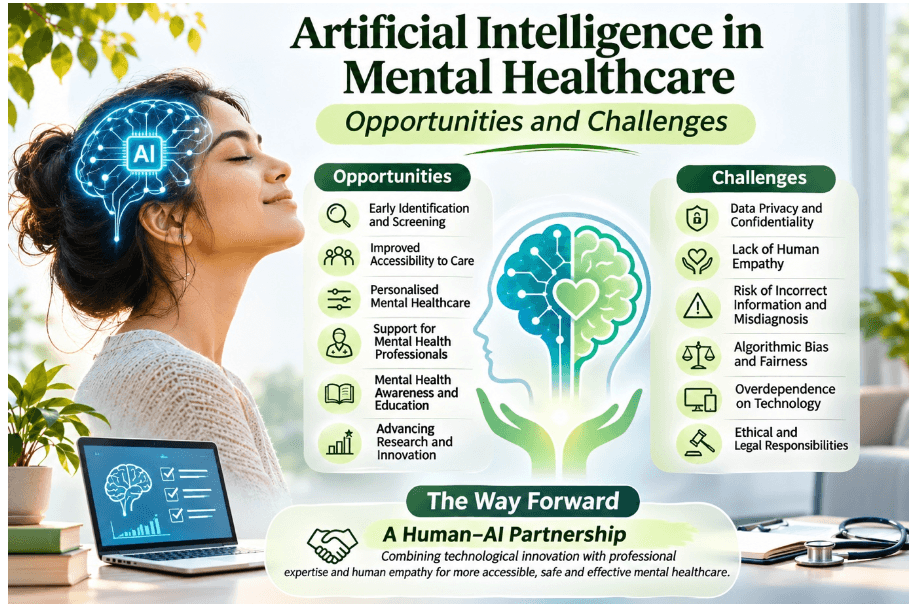
1. Opportunities of Artificial Intelligence in Mental Healthcare
A. Early Identification and Mental Health Screening
One of the most promising applications of AI is its potential to support early identification of mental health concerns.
Many individuals experience psychological distress without recognising its symptoms. Others may hesitate to seek professional help because of stigma, fear or a lack of awareness.
AI-powered screening tools can use structured questionnaires and user-provided information to identify possible indicators of psychological difficulties.
For example, a digital screening platform may ask questions related to:
· Mood and emotional experiences.
· Sleep patterns.
· Stress and anxiety levels.
· Concentration and motivation.
· Changes in appetite and behaviour.
· Social withdrawal and daily functioning.
Based on the responses, the system can provide preliminary feedback and suggest whether professional assessment may be appropriate.
Such screening tools can encourage individuals to recognise their concerns earlier. However, screening results are not equivalent to a clinical diagnosis and should be interpreted appropriately.
B. Improving Accessibility to Mental Health Support
Accessibility remains one of the biggest challenges in mental healthcare.
People living in remote areas, students, working professionals and individuals with limited mobility may find it difficult to access regular psychological services.
AI-powered digital platforms can provide mental health information, self-help resources and preliminary screening tools through smartphones and computers.
These platforms can make certain resources available beyond traditional clinic hours and help individuals take an initial step towards seeking support.
For countries like India, where mental healthcare services are unevenly distributed, responsible digital solutions may contribute to reducing accessibility gaps.
C. Personalised Mental Healthcare
Every individual experiences psychological difficulties differently.
Two people experiencing anxiety may have different triggers, symptoms, coping mechanisms and treatment requirements.
AI can analyse information from multiple sources, including screening questionnaires, symptom records and self-reported experiences, to help identify individual patterns.
This information may assist mental health professionals in understanding a person's needs and considering appropriate interventions.
For example, an AI-assisted platform may help track changes in stress levels over time and identify patterns associated with sleep, work pressure or lifestyle habits.
However, treatment decisions must remain under the supervision of qualified healthcare professionals.
D. Supporting Mental Health Professionals
AI is not only useful for individuals seeking support; it can also assist psychologists, psychiatrists and other healthcare professionals.
Some applications include:
· Organising patient-reported information.
· Supporting clinical documentation.
· Monitoring symptom changes.
· Identifying patterns in psychological assessment data.
· Providing educational resources.
· Assisting with treatment progress monitoring.
By reducing certain administrative responsibilities, AI may allow professionals to devote more time to clinical interactions, therapeutic relationships and patient care.
Importantly, AI should support professional judgement rather than replace it.
E. Mental Health Awareness and Education
Lack of awareness is a significant barrier to mental healthcare.
Many individuals are unable to distinguish between ordinary emotional experiences and symptoms that may require professional attention.
AI-powered educational platforms can provide accessible information about anxiety, depression, stress, OCD, emotional regulation and other psychological concerns.
They can also offer information about coping strategies, mindfulness, sleep hygiene and the importance of seeking professional help.
When designed responsibly, such tools can encourage mental health literacy and reduce misconceptions surrounding psychological conditions.
F. Supporting Research and Innovation
AI has the potential to contribute to psychological and psychiatric research by helping researchers analyse large datasets and identify patterns that may otherwise be difficult to detect.
Potential research applications include:
· Studying patterns associated with depression and anxiety.
· Analysing psychological assessment data.
· Exploring behavioural and cognitive patterns.
· Supporting neuroscience research.
· Evaluating treatment outcomes.
· Identifying areas for future clinical investigation.
These applications may contribute to the development of more personalised and evidence-informed mental healthcare approaches.
2. Challenges of Artificial Intelligence in Mental Healthcare
Despite its potential, AI also introduces important ethical, clinical and technological challenges.
A. Data Privacy and Confidentiality
Mental health information is extremely sensitive.
Individuals may share personal experiences, relationship difficulties, traumatic memories, medical histories and other confidential information through digital platforms.
If this information is not adequately protected, it may create serious privacy risks.
Mental healthcare platforms must therefore prioritise:
· Secure data storage.
· Encryption and access controls.
· Informed consent.
· Transparent privacy policies.
· Responsible data handling.
· Compliance with applicable data protection laws.
Protecting patient confidentiality must remain a fundamental requirement of digital mental healthcare.
B. Lack of Human Empathy
One of the most important elements of psychological counselling is the therapeutic relationship between the client and the mental health professional.
Counselling involves more than exchanging information. It requires empathy, active listening, emotional understanding, sensitivity and the ability to respond appropriately to complex human experiences.
AI can generate supportive responses and recognise certain patterns in language, but it does not experience human emotions or possess genuine human empathy.
A person experiencing grief, trauma or severe emotional distress may require nuanced understanding and professional therapeutic intervention that automated systems cannot reliably provide.
Therefore, AI should complement human care rather than attempt to replicate the complete therapeutic relationship.
C. Risk of Incorrect Information and Misdiagnosis
AI systems can sometimes generate inaccurate, incomplete or misleading information.
In mental healthcare, such errors can have significant consequences.
For example, an individual experiencing persistent depressive symptoms may receive inappropriate reassurance from an unreliable digital tool and delay seeking professional help.
Similarly, AI-based screening systems may incorrectly identify or overlook certain psychological symptoms.
It is therefore essential to communicate the limitations of AI tools clearly and ensure that clinical diagnoses and treatment decisions are made by qualified professionals.
D. Algorithmic Bias and Fairness
AI systems learn from the data used to develop and train them.
If training datasets do not adequately represent different populations, the resulting systems may perform differently across age groups, languages, genders, cultures and socioeconomic backgrounds.
This is particularly important in a diverse country like India, where psychological experiences and the language used to describe emotional distress may vary considerably.
AI systems must be evaluated for fairness, accuracy and cultural sensitivity before being used in mental healthcare settings.
E. Overdependence on Technology
Although digital platforms can improve accessibility, excessive reliance on AI may discourage some individuals from seeking appropriate human support.
Mental health concerns are often complex and influenced by biological, psychological, social and environmental factors.
A chatbot or automated screening system cannot independently understand every aspect of an individual's life.
Technology should therefore be used as an entry point to appropriate support, not as a substitute for professional care.
F. Ethical and Legal Responsibilities
The use of AI in mental healthcare raises important questions about accountability, informed consent, clinical responsibility and patient safety.
Organisations developing these technologies must establish clear guidelines regarding:
· Who is responsible when an AI system provides incorrect information?
· How should sensitive psychological data be used?
· What happens when a user expresses suicidal thoughts?
· How can users challenge or correct inaccurate information?
· When should an AI system refer an individual to a professional?
Clear governance and appropriate clinical oversight are necessary to ensure that technology serves individuals safely and responsibly.
3. AI and the Future of Mental Healthcare in India
India faces several challenges in delivering accessible mental healthcare, including unequal distribution of services, social stigma, limited awareness and gaps in the availability of trained professionals.
Digital healthcare technologies may help address some of these barriers.
AI-powered platforms can potentially support early screening, psychological education, symptom monitoring and connections with qualified professionals.
For students, such platforms may provide initial information about academic stress, examination anxiety and emotional difficulties.
For working professionals, they may offer tools for understanding burnout, workplace stress and emotional exhaustion.
For individuals living in underserved communities, digital platforms may improve access to reliable mental health information and help identify appropriate pathways to care.
However, these solutions must be developed with attention to India's linguistic, cultural and socioeconomic diversity.
Technology should make mental healthcare more inclusive rather than create another barrier for people who lack digital access or literacy.
4. The Human-AI Partnership: A Better Approach to Mental Healthcare
The future of mental healthcare should not be viewed as a competition between human professionals and Artificial Intelligence.
Instead, the most promising approach is a collaborative model in which technology supports professionals and improves the overall patient experience.
Consider an example:
An individual experiencing persistent stress uses an AI-powered mental health screening platform. The platform identifies possible indicators of anxiety and recommends consulting a qualified psychologist.
The psychologist then conducts a comprehensive assessment, understands the individual's personal circumstances and develops an appropriate intervention plan.
During the course of care, digital tools may help monitor symptoms and record progress, while the psychologist continues to provide therapeutic support and make clinical decisions.
In this model, AI improves accessibility and supports information management, while the mental health professional provides clinical expertise, empathy and individualised care.
The goal should not be to replace human intelligence with artificial intelligence, but to combine technological innovation with human understanding.
5. Responsible AI: What Should the Future Look Like?
For AI to become a meaningful part of mental healthcare, innovation must be accompanied by responsibility.
Some important priorities include:
Clinical Validation: AI-based screening and assessment tools should be evaluated for reliability, validity and suitability for their intended use.
Human Oversight: Qualified mental health professionals should remain involved in clinical decision-making and high-risk situations.
Data Protection: Personal psychological information must be handled securely and transparently.
Transparency: Users should understand when they are interacting with AI and what its limitations are.
Inclusivity: Systems should be designed and tested for different languages, cultures and populations.
Crisis Management: Platforms must have clear procedures for responding to disclosures of self-harm, suicidal thoughts or other urgent mental health concerns.
Responsible implementation will determine whether AI becomes a trustworthy resource in mental healthcare.
Conclusion: Technology Can Support Care, but Human Connection Remains Essential
Artificial Intelligence is opening new possibilities in mental healthcare. From preliminary screening and personalised support to clinical research and digital accessibility, AI has the potential to improve how mental health resources are delivered.
However, technological advancement must not come at the cost of privacy, empathy, clinical accuracy or patient safety.
Mental healthcare is fundamentally about understanding people, their emotions, experiences and individual circumstances. While AI can assist in analysing information and identifying patterns, the human dimensions of care remain essential.
The future of mental healthcare lies in creating a balanced partnership between technology and qualified professionals.
At Positive Mind Care & Research Centre, we believe that innovation, psychological science and human understanding must work together to make mental healthcare more accessible, informed and effective.
Our AI-driven mental health initiatives aim to encourage greater awareness and support early identification of psychological concerns, while recognising the importance of professional assessment and appropriate clinical care.
At Positive Mind Care & Research Centre, we believe that innovation, psychological science and human understanding must work together to make mental healthcare more accessible, informed and effective.
Taking this vision forward, Positive Mind Care has developed an AI-driven Mental Health Portal, designed to make preliminary mental health screening more accessible and convenient. The portal aims to encourage individuals to become more aware of their psychological well-being through AI-assisted screening, helping identify potential mental health concerns at an early stage and guiding users towards appropriate professional support.
By integrating technology with psychological science, Positive Mind Care aims to bridge the gap between mental health awareness and professional care, making the first step towards understanding one's mental health easier and more approachable.
Artificial Intelligence may transform the way we deliver mental healthcare, but compassion, empathy and human connection must always remain at its heart. At Positive Mind Care, we envision a future where technology empowers individuals, supports mental health professionals and makes quality mental healthcare more accessible to everyone.
In addition to digital innovation, Positive Mind Care offers Deep Transcranial Magnetic Stimulation (Deep TMS), an advanced, non-invasive brain stimulation treatment that uses magnetic pulses to stimulate specific brain regions. Deep TMS offers an additional treatment option for individuals with certain psychiatric conditions, including depression and OCD, subject to clinical evaluation and professional supervision.
By bringing together Artificial Intelligence, psychological assessment, counselling and advanced treatment technologies such as Deep TMS, Positive Mind Care aims to contribute to a more comprehensive and personalised approach to mental healthcare.Our vision is to bridge the gap between mental health awareness, early identification and appropriate professional intervention, making the journey towards better mental health more accessible and informed.
Artificial Intelligence may transform the way we deliver mental healthcare, and advanced technologies such as Deep TMS may expand treatment possibilities, but compassion, empathy and human connection must always remain at the heart of care.
At Positive Mind Care, we envision a future where technology empowers individuals, supports mental health professionals and makes quality mental healthcare more accessible to everyone.