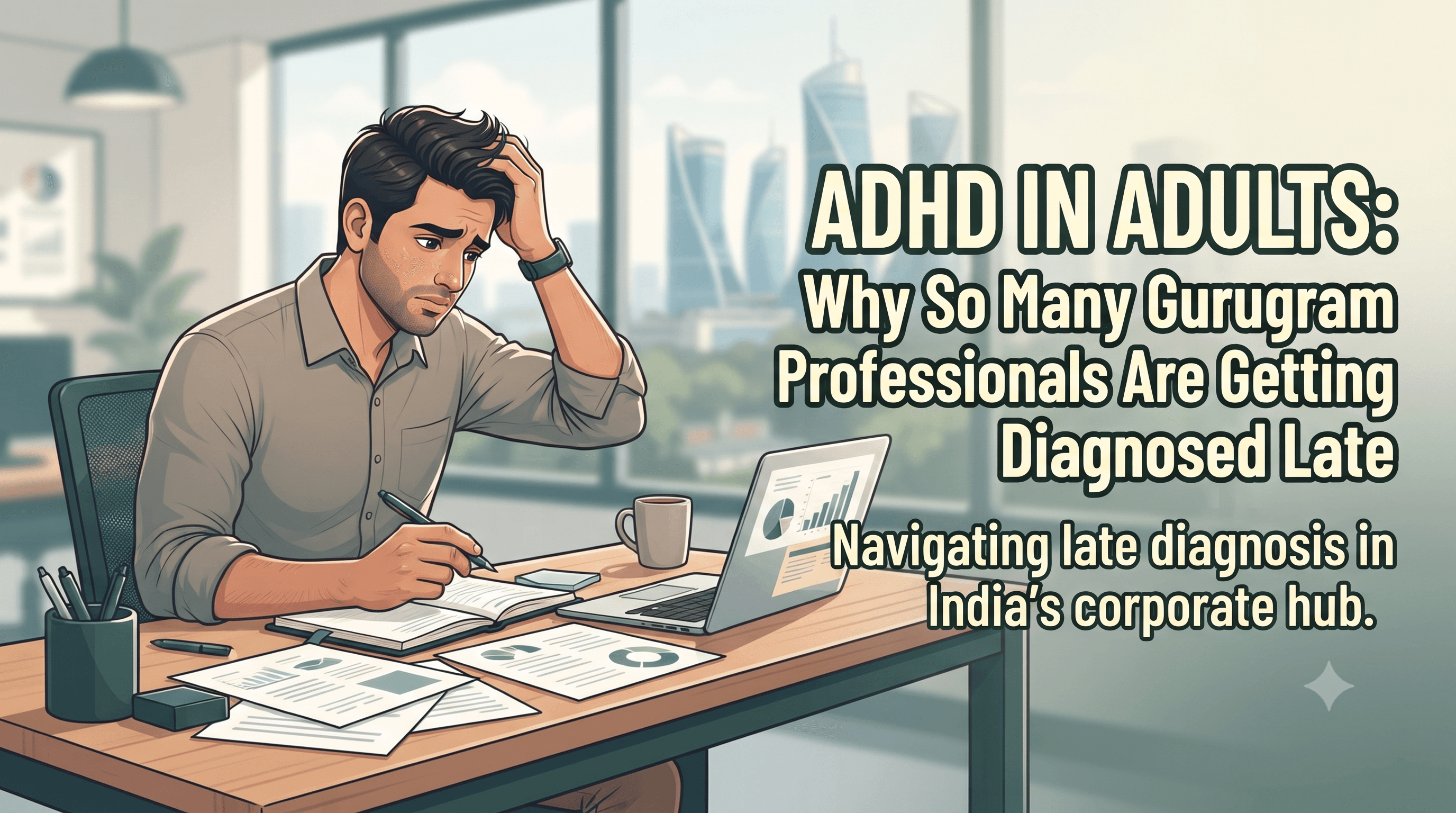
There is a quiet epidemic unfolding in Gurugram's offices, co-working spaces, and corporate campuses that very few people are talking about openly. Thousands of working professionals — many of them high-achieving, intelligent, and outwardly successful — are discovering for the first time in their thirties, forties, or even fifties that they have Attention Deficit Hyperactivity Disorder (ADHD). Not childhood ADHD that they somehow missed, but adult ADHD that has been shaping their entire career, relationships, and self-perception for decades — often without a single clinician identifying it.
This blog explores why adult ADHD goes undiagnosed for so long, how it specifically shows up in Gurugram's professional population, why the consequences extend far beyond "difficulty focusing," and what comprehensive, evidence-based treatment now looks like for adults who finally get the answers they've been looking for.
Why ADHD in Adults Is So Frequently Missed
ADHD has historically been considered a childhood condition — the hyperactive boy who can't sit still in class. This stereotype is deeply misleading and has caused generations of adults to be dismissed, misdiagnosed, or simply never evaluated. The reality is that ADHD persists into adulthood in the majority of people who have it, and in many adults — particularly women and high-intelligence individuals — it was never identified in childhood to begin with.
In high-achieving adults, ADHD often remains hidden beneath compensatory strategies: working longer hours to compensate for inefficiency, using extreme deadline pressure as the only reliable focus trigger, building elaborate organizational systems, or relying on high-interest domains to maintain engagement. The compensation works, until it doesn't. A promotion, a new baby, a more complex project, or simply accumulated exhaustion can break down these mechanisms, revealing the underlying difficulty in a way that suddenly feels unmanageable.
What Adult ADHD Actually Looks Like in Gurugram's Corporate World
Adult ADHD doesn't look like a child bouncing off walls. In a Gurugram professional, it might look like starting every morning with a clear task list and ending every evening having completed none of the important items while spending hours on low-priority tasks. It looks like brilliant ideas that never get executed because the transition from inspiration to systematic implementation feels impossible. A desk covered in incomplete projects, a reputation for missing deadlines despite genuine effort, or a persistent sense of underachieving that doesn't match intelligence or effort.
It shows up as chronic lateness that is genuinely embarrassing and seemingly unfixable. As meetings where the person appears present but has lost the thread within three minutes. As emails read and immediately forgotten. As an inability to read contracts or reports without re-reading the same paragraph repeatedly. As impulsive decisions financial, professional, relational that the person regrets immediately but continues making.
Emotionally, adult ADHD often manifests as rejection sensitive dysphoria — an extreme, disproportionate emotional response to perceived criticism or failure that can look like severe mood swings. This is often the most painful aspect of adult ADHD and the one most frequently misattributed to personality problems or depression.
Why Gurugram's Culture Makes ADHD Harder to Live With
Gurugram's corporate environment creates a specific relationship with ADHD. The high-stimulation, deadline-driven, constantly novel nature of startup and corporate culture can actually help some ADHD individuals thrive hyperfocus capacity can produce extraordinary output in short bursts. On the other hand, demands for sustained attention in meetings, systematic project management, and bureaucratic process are precisely where ADHD creates the most impairment.
The result is often a person who appears brilliant in some contexts and inexplicably chaotic in others confusing to managers, colleagues, and the person themselves. In a performance-evaluated environment like Gurugram, missed deadlines and presentation chaos affect career trajectory in ways that compound the shame and self-blame many undiagnosed ADHD adults already carry for years.
Common Misdiagnoses Before the Correct One
One of the most damaging aspects of late ADHD diagnosis is the years spent being treated for something else. Because ADHD in adults frequently presents with anxiety, depression, sleep problems, and emotional dysregulation, these symptoms are often treated as primary conditions rather than recognized as downstream consequences of undiagnosed ADHD.
A person with ADHD who has spent years failing to meet their own standards, disappointing others, and struggling with tasks that seem easy for everyone else typically develops significant anxiety and depression as a result. Treating the anxiety or depression in isolation without identifying the ADHD driving both produces limited results because the source remains unaddressed. This is why adults with ADHD frequently carry long treatment histories with limited success before someone finally asks the right questions.
Diagnosis: What the Process Looks Like
Diagnosing ADHD in adults requires a comprehensive clinical assessment that goes beyond a brief questionnaire. At clinics like Positive Mind Care, Gurugram, this involves a detailed clinical interview covering childhood and adult symptom history, standardized ADHD rating scales, a review of academic and professional history for ADHD-consistent patterns, and careful assessment to distinguish ADHD from or identify it alongside co-occurring conditions.
ADHD diagnosis in adults is a clinical determination made by a qualified psychiatrist not a screening test or online quiz. Identifying the correct subtype (primarily inattentive, hyperactive-impulsive, or combined) is foundational to designing an effective treatment plan.
Treatment for Adult ADHD: A Comprehensive Approach
Adult ADHD treatment works best as a multimodal program. Stimulant medication first-line pharmacological treatment can produce dramatic improvements in attention, impulse control, and emotional regulation. For many adults, the experience of functioning on the right medication is profoundly meaningful often described as seeing clearly for the first time.
CBT adapted for ADHD, addressing procrastination, time blindness, organizational systems, and negative self-belief built up over decades, significantly improves outcomes beyond medication alone. Coaching support provides day-to-day executive function guidance. For adults with treatment-resistant ADHD symptoms or comorbid depression, Deep TMS therapy directly addresses the prefrontal cortex dysfunction underlying both conditions and offers an evidence-based additional treatment option.
The Emotional Weight of Late Diagnosis
For many adults, receiving an ADHD diagnosis is a profoundly emotional experience. There is grief for years spent blaming themselves for a neurologically-grounded difficulty. Relief finally having an explanation that fits a lifetime's pattern. And renewed possibility because understanding what has been happening is the first and most important step toward changing it.
Frequently Asked Questions
Q1. Can ADHD develop in adulthood, or is it always present from childhood? ADHD is a neurodevelopmental condition present from birth, but frequently unrecognized in childhood and only identified in adulthood when demands exceed compensatory capacity.
Q2. Is ADHD overdiagnosed in adults? In India, the more significant problem is substantial underdiagnosis, particularly in women, high achievers, and adults who compensated through intelligence.
Q3. Will ADHD medication affect my ability to work? For most adults, ADHD medication significantly improves work performance. Cognitive dulling concerns are generally associated with incorrect dosing rather than the medication itself.
Q4. Where can I get an adult ADHD assessment in Gurugram? Positive Mind Care, Gurugram, offers comprehensive adult ADHD assessment and treatment, including medication management, CBT, and advanced Deep TMS therapy where needed.
Conclusion
Adult ADHD is not a personality flaw or an excuse — it is a real, neurologically grounded disorder that has shaped the lives of millions of professionals without ever being properly named or treated. If the patterns described in this blog resonate with your own experience, a professional evaluation is the most important investment you can make in your professional effectiveness, your relationships, and your quality of life. You deserve to know what's actually happening — and you deserve treatment that works.